web.lemoyne.edu/giunta
Indice
- Elements and Atoms: Elements
- Elements and Atoms: Chapter 1 Four Elements: Aristotle
- Elements and Atoms: Chapter 2 Robert Boyle, a Sceptical Chymist
- PHYSIOLOGICAL[1] CONSIDERATIONS Touching The experiments wont to be employed to evince either the IV Peripatetick Elements[2], or the III Chymical Principles[3] of Mixt Bodies[4] {#physiological1-considerations-touching-the-experiments-wont-to-be-employed-to-evince-either-the-iv-peripatetick-elements2-or-the-iii-chymical-principles3-of-mixt-bodies4 align="CENTER"}
- THE SCEPTICAL CHYMIST OR, A Paradoxical Appendix to the Foregoing Treatise. {#the-sceptical-chymist-or-a-paradoxical-appendix-to-the-foregoing-treatise. align="CENTER"}
- Notes
- References
- Elements and Atoms: Chapter 3 Lavoisier's Elements of Chemistry
- Elements and Atoms: Chapter 4 Oxygen, an Element in Air: Joseph Priestley
- Elements and Atoms: Chapter 5 Fire and Earth: Lavoisier
- Elements and Atoms: Chapter 6 Water is not an element: Lavoisier
- Report of a memoir read by M. Lavoisier at the public session of the Royal Academy of Sciences of November 12, on the nature of water and on experiments which appear to prove that this substance is not strictly speaking an element but that it is susceptible of decomposition and recomposition
- Notes
- References
- Elements and Atoms: Atoms
https://web.lemoyne.edu/giunta/EA/ELEMENTS.HTML
Elements and Atoms: Elements
What is an element? Perusal of the reference shelf of a local library is likely to turn up two quite different definitions. Recent editions of such general-purpose works as Encyclopedia Britannica (15 th ed., 1989) and the Oxford English Dictionary (2 nd ed. CD-ROM, 1992) define a chemical element as a substance that cannot be decomposed into simpler substances by ordinary chemical processes. The McGraw-Hill Dictionary of Scientific and Technical Terms (5 th ed., 1994), however, defines an element as a substance made up of atoms with the same atomic number. The Concise Encyclopedia Chemistry (de Gruyter, 1994) gives a similar definition, adding, "This definition has supplanted the classical definition of an E. as a substance which cannot be decomposed into simpler substances by chemical or physical means." The difference in definitions, then, represents a change over time. (The Oxford English Dictionary definition conveys a strong sense of anachronism by its parenthetical observation that more than 70 elements are known, a statement which has been true for over a century. Yet the newer definition has not completely displaced the classical one even from introductory chemistry textbooks [Roundy 1988].)
What should we make of these two quite different-sounding definitions? After all, the list of elements discovered and characterized by scientists using the older definition are still elements under the newer definition. Even so, the different definitions embody important conceptual differences. The classical definition evokes macroscopic processes of analytical "wet" chemistry, and is silent on the structure of elements; the modern definition is a microscopic one, inseparable from an understanding of the structure of matter and of particular details of the atomic nucleus. The alteration in definition reminds us that as knowledge changes, so does the language which expresses that knowledge. Sometimes new words are used to express new ideas; sometimes old words are given new meanings.
The selections presented in the first part of this book follow the term element still deeper into the past than the "classic" definition mentioned above. The book begins with a pre-scientific notion, the four elements of the ancients. Aristotle 's explanation of the elements does not exemplify scientific reasoning. Aristotle did employ empirical observations in some of his writings, but did not make them the foundation of his philosophical system. Reading Aristotle can be quite difficult because the concepts behind words such as element and matter have changed so much in the intervening time. The next selection jumps ahead two millennia to Robert Boyle, who insisted on experiments and observations as the basis for deciding what were elements. Boyle's definition of element is almost the "classical" definition given above. A century after Boyle, Antoine Lavoisier formulated that classical definition, in a selection which also includes interesting observations on the role of language in conveying scientific knowledge. The final three selections in this section illustrate the downfall from elementary status of each of the four elements of the ancients. Joseph Priestley was not the first to distinguish among different kinds of "airs" (gases); however, his work along those lines is voluminous. His description of the gas we now call oxygen is reproduced here. Lavoisier's work on combustion, which relied greatly on the discovery of oxygen, initiated the understanding of fire as a process and not a material, let alone an element. His explanation of the related process of calcination showed that metals were simpler substances than their "earths" or metal oxides. Finally, the compound nature of water was demonstrated by several investigators in the 1780s. The section concludes with a selection describing Lavoisier's work on the subject.
Reference
Willard H. Roundy, Jr., "What is an element?" Journal of Chemical Education 66, 729-30 (1989)
Back to the top of the table of contents of Elements and Atoms.
Back to the top of Classic Chemistry.
Elements and Atoms: Chapter 1 Four Elements: Aristotle
Aristotle (384-322 BCE; view sculpture bust at the Galileo Project, Rice University) is not generally considered a chemist, and for good reason. His approach to understanding the natural world was not a scientific one. In fact, the authority attached to Aristotle nearly two millennia after his death was one of the main obstacles in the path of the scientific outlook as it emerged in the 17[^th^]{.underline} century. The experimental method of putting hypothetical explanations to an empirical test was unknown to Aristotle and his contemporaries. Although he was not a bad observer in some instances, Aristotle's mode of explanation was rationalistic rather than empirical.

If Aristotle was not a scientist, he was especially not a chemist: "Aristotle's chemistry, like Socrates' book, does not exist. ... the absence of material of a specifically chemical character in ancient Greek natural philosophy has largely escaped the attention it deserves." [Horne 1966]. Aristotle wrote on subjects which are now part of the disciplines of biology and physics, but not on chemical subjects, and in this respect, he was no different from other figures in ancient Greek philosophy.
So why begin a book of case studies in scientific method illustrating chemical themes with a selection which is neither scientific nor chemical? Aristotle's conception of the elements, even though it was concerned primarily with physical aspects of matter, was one which later chemists had to confront. (See next chapter.) Besides, this collection explores the themes of atoms and elements from both physical and chemical perspectives. Finally, the unscientific discourse of Aristotle can serve as a point of reference and contrast to the scientific discourses presented in the remainder of the book.[1]
Note
[1]My characterization of Aristotle as "unscientific" is not a value judgment; I use the term to contrast Aristotle's way of knowing with a mode (the scientific) that relies heavily on empirical evidence. Historians may object to my judging Aristotle by standards of a later time. Such judgments do not make for good history (i.e., for understanding Aristotle in the context of his time); they do, however, facilitate (at least by contrast) understanding investigations that are scientific.
excerpt from
De Generatione et Corruptione[1]
translated by H. H. Joachim in W. D. Ross, ed., The Works of Aristotle, vol. 2 (Oxford: Oxford, 1930)
Book II, Chapter 1
We have explained under what conditions "combination," "contact," and "action-passion" are attributable to the things which undergo natural change. Further, we have discussed "unqualified" coming-to-be and passing-away, and explained under what conditions they are predicable, of what subject, and owing to what cause. Similarly, we have also discussed "alteration," and explained what "altering" is and how it differs from coming-to-be and passing-away. But we have still to investigate the so-called "elements" of bodies.
For the complex substances whose formation and maintenance are due to natural processes all presuppose the perceptible bodies as the condition of their coming-to-be and passing-away: but philosophers disagree in regard to the matter which underlies these perceptible bodies.[2] Some maintain it is single, supposing it to be, e.g. Air or Fire, or an "intermediate" between these two (but still a body with a separate existence). Others, on the contrary, postulate two or more materials--ascribing to their "association" and "dissociation," or to their "alteration," the coming-to-be and passing-away of things. (Some, for instance, postulate Fire and Earth: some add Air, making three: and some, like Empedokles, reckon Water as well, thus postulating four.[3])
Now we may agree that the primary materials, whose change (whether it be "association and dissociation" or a process of another kind) results in coming-to-be and passing-away, are rightly described as "originative sources, i.e. elements." But (i) those thinkers are in error who postulate, beside the bodies we have mentioned, a single matter--and that corporeal and separable matter. For this "body" of theirs cannot possibly exist without a "perceptible contrariety": this "Boundless," which some thinkers identify with the "original real," must be either light or heavy, either cold or hot. And (ii) what Plato has written in the Timaeus is not based on any precisely-articulated conception. For he has not stated clearly whether his "Omnirecipient" exists in separation from the "elements"; nor does he make any use of it. He says, indeed, that it is a substratum prior to the so-called "elements"--underlying them, as gold underlies the things that are fashioned of gold. (And yet this comparison, if thus expressed, is itself open to criticism. Things which come-to-be and pass-away cannot be called by the name of the material out of which they have come-to-be: it is only the results of "alteration" which retain the name of the substratum whose "alterations" they are. However, he actually says that "far the truest account is to affirm that each of them is 'gold.'") Nevertheless he carries his analysis of the "elements"--solids though they are--back to "planes," and it is impossible for "the Nurse" (i.e. the primary matter) to be identical with "the planes."
Our own doctrine is that although there is a matter of the perceptible bodies (a matter out of which the so-called "elements" come-to-be), it has no separate existence, but is always bound up with a contrariety.[4] A more precise account of these presuppositions has been given in another work[5]: we must, however, give a detailed explanation of the primary bodies as well, since they too are similarly derived from the matter. We must reckon as an "originative source" and as "primary" the matter which underlies, though it is inseparable from, the contrary qualities: for "the hot" is not matter for "the cold" nor "the cold" for "the hot," but the substratum is matter for them both. We therefore have to recognize three "originative sources": firstly that which is potentially perceptible body, secondly the contrarieties (I mean, e.g., heat and cold), and thirdly Fire, Water, and the like. Only "thirdly," however: for these bodies change into one another (they are not immutable as Empedokles and other thinkers assert, since "alteration" would then have been impossible), whereas the contrarieties do not change.
Nevertheless, even so the question remains: What sorts of contrarieties, and how many of them, are to be accounted "originative sources" of body?[6] For all the other thinkers assume and use them without explaining why they are these or why they are just so many.
Book II, Chapter 2
Since, then, we are looking for "originative sources" of perceptible body; and since "perceptible" is equivalent to "tangible," and "tangible" is that of which the perception is touch; it is clear that not all the contrarieties constitute "forms" and "originative sources" of body, but only those which correspond to touch. For it is in accordance with a contrariety--a contrariety, moreover, of tangible qualities--that the primary bodies are differentiated. That is why neither whiteness (and blackness), nor sweetness (and bitterness), nor (similarly) any quality belonging to the other perceptible contrarieties either, constitutes an "element."[7] And yet vision is prior to touch, so that its object also is prior to the object of touch. The object of vision, however, is a quality of tangible body not qua tangible, but qua something else--qua something which may well be naturally prior to the object of touch.
Accordingly, we must segregate the tangible differences and contrarieties, and distinguish which amongst them are primary. Contrarieties correlative to touch are the following: hot-cold, dry-moist, heavy-light, hard-soft, viscous-brittle, rough-smooth, coarse-fine. Of these (i) heavy and light are neither active nor susceptible. Things are not called "heavy" and "light" because they act upon, or suffer action from, other things. But the "elements" must be reciprocally active and susceptible, since they "combine" and are transformed into one another. On the other hand (ii) hot and cold, and dry and moist, are terms, of which the first pair implies power to act and the second pair susceptibility. "Hot" is that which "associates" things of the same kind (for "dissociating," which people attribute to Fire as its function, is "associating" things of the same class, since its effect is to eliminate what is foreign), while "cold" is that which brings together, i.e. "associates," homogeneous and heterogeneous things alike. And moist is that which, being readily adaptable in shape, is not determinable by any limit of its own: while "dry" is that which is readily determinable by its own limit, but not readily adaptable in shape.[8]
From moist and dry are derived (iii) the fine and coarse, viscous and brittle, hard and soft, and the remaining tangible differences. For (a) since the moist has no determinate shape, but is readily adaptable and follows the outline of that which is in contact with it, it is characteristic of it to be "such as to fill up." Now "the fine" is "such as to fill up." For "the fine" consists of subtle particles; but that which consists of small particles is "such as to fill up," inasmuch as it is in contact whole with whole--and "the fine" exhibits this character in a superlative degree. Hence it is evident that the fine derives from the moist, while the coarse derives from the dry. Again (b) "the viscous" derives from the moist: for "the viscous" (e.g. oil) is a "moist" modified in a certain way. "The brittle," on the other hand, derives from the dry: for "brittle" is that which is completely dry--so completely, that its solidification has actually been due to failure of moisture. Further © "the soft" derives from the moist. For "soft" is that which yields to pressure by retiring into itself, though it does not yield by total displacement as the moist does--which explains why the moist is not "soft," although "the soft" derives from the moist. "The hard," on the other hand, derives from the dry: for "hard" is that which is solidified, and the solidified is dry.
The terms "dry" and "moist" have more senses than one. For "the damp," as well as the moist, is opposed to the dry: and again "the solidified," as well as the dry, is opposed to the moist. But all these qualities derive from the dry and moist we mentioned first. For (i) the dry is opposed to the damp: i.e. "damp" is that which has foreign moisture on its surface ("sodden" being that which is penetrated to its core), while "dry" is that which has lost foreign moisture. Hence it is evident that the damp will derive from the moist, and "the dry" which is opposed to it will derive from the primary dry. Again (ii) the "moist" and the solidified derive in the same way from the primary pair. For "moist" is that which contains moisture of its own deep within it ("sodden" being that which is deeply penetrated by foreign moisture), whereas "solidified" is that which has lost this inner moisture. Hence these too derive from the primary pair, the "solidified" from the dry and the "liquefiable" from the moist.
It is clear, then, that all the other differences reduce to the first four, but that these admit of no further reduction. For the hot is not essentially moist or dry, nor the moist essentially hot or cold: nor are the cold and the dry derivative forms, either of one another or of the hot and the moist. Hence these must be four.
Book II, Chapter 3
The elementary qualities are four, and any four terms can be combined in six couples. Contraries, however, refuse to be coupled: for it is impossible for the same thing to be hot and cold, or moist and dry.[9] Hence it is evident that the "couplings" of the elementary qualities will be four: hot with dry and moist with hot, and again cold with dry and cold with moist. And these four couples have attached themselves to the apparently "simple" bodies (Fire, Air, Water, and Earth) in a manner consonant with theory. For Fire is hot and dry, whereas Air is hot and moist (Air being a sort of aqueous vapour); and Water is cold and moist, while Earth is cold and dry.[10] Thus the differences are reasonably distributed among the primary bodies, and the number of the latter is consonant with theory. For all who make the simple bodies "elements" postulate either one, or two, or three, or four. Now (i) those who assert there is one only, and then generate everything else by condensation and rarefaction, are in effect making their "originative sources" two, viz. the rare and the dense, or rather the hot and the cold: for it is these which are the moulding forces, while the "one" underlies them as a "matter."[11] But (ii) those who postulate two from the start--as Parmenides postulated Fire and Earth--make the intermediates (e.g. Air and Water) blends of these. The same course is followed (iii) by those who advocate three. (We may compare what Plato does in "The Divisions": for he makes "the middle" a blend.) Indeed, there is practically no difference between those who postulate two and those who postulate three, except that the former split the middle "element" into two, while the latter treat it as only one. But (iv) some advocate four from the start, e.g. Empedokles: yet he too draws them together so as to reduce them to the two, for he opposes all the others to Fire.
In fact, however, fire and air, and each of the bodies we have mentioned, are not simple, but blended. The "simple" bodies are indeed similar in nature to them, but not identical with them. Thus the "simple" body corresponding to fire is "such-as-fire," not fire: that which corresponds to air is "such-as-air:" and so on with the rest of them.[12] But fire is an excess of heat, just as ice is an excess of cold. For freezing and boiling are excesses of heat and cold [sic] respectively. Assuming, therefore, that ice is a freezing of moist and cold, fire analogously will be a boiling of dry and hot: a fact, by the way, which explains why nothing comes-to-be either out of ice or out of fire.[13]
The "simple" bodies, since they are four, fall into two pairs which belong to the two regions, each to each: for Fire and Air are forms of the body moving towards the "limit," while Earth and Water are forms of the body which moves towards the "centre." Fire and Earth, moreover, are extremes and purest: Water and Air, on the contrary are intermediates and more like blends. And, further, the members of either pair are contrary to those of the other, Water being contrary to Fire and Earth to Air; for the qualities constituting Water and Earth are contrary to those that constitute Fire and Air. Nevertheless, since they are four, each of them is characterized par excellence a single quality: Earth by dry rather than by cold, Water by cold rather than by moist, Air by moist rather than by hot, and Fire by hot rather than by dry.
Book II, Chapter 4
It has been established before that the coming-to-be of the "simple" bodies is reciprocal. At the same time, it is manifest, even on the evidence of perception, that they do come-to-be: for otherwise there would not have been "alteration," since "alteration" is change in respect to the qualities of the objects of touch. Consequently, we must explain (i) what is the manner of their reciprocal transformation, and (ii) whether every one of them can come-to-be out of every one--or whether some can do so, but not others.
Now it is evident that all of them are by nature such as to change into one another: for coming-to-be is a change into contraries and out of contraries, and the "elements" all involve a contrariety in their mutual relations because their distinctive qualities are contrary. For in some of them both qualities are contrary--e.g. in Fire and Water, the first of these being dry and hot, and the second moist and cold: while in others one of the qualities (though only one) is contrary--e.g. in Air and Water, the first being moist and hot, and the second moist and cold. It is evident, therefore, if we consider them in general, that every one is by nature such as to come-to-be out of every one: and when we come to consider them severally, it is not difficult to see the manner in which their transformation is effected. For, though all will result from all, both the speed and the facility of their conversion will differ in degree.[14]
Thus (i) the process of conversion will be quick between those which have interchangeable "complementary factors," but slow between those which have none. The reason is that it is easier for a single thing to change than for many. Air, e.g., will result from Fire if a single quality changes: for Fire, as we saw, is hot and dry while Air is hot and moist, so that there will be Air if the dry be overcome by the moist. Again, Water will result from Air if the hot be overcome by the cold: for Air, as we saw, is hot and moist while Water is cold and moist, so that, if the hot changes, there will be Water. So too, in the same manner, Earth will result from Water and Fire from Earth, since the two "elements" in both these couples have interchangeable "complementary factors." For Water is moist and cold while Earth is cold and dry--so that, if the moist be overcome, there will be Earth: and again, since Fire is dry and hot while Earth is cold and dry, Fire will result from Earth if the cold pass-away.
It is evident, therefore, that the coming-to-be of the "simple" bodies will be cyclical; and that this cyclical method of transformation is the easiest, because the consecutive "elements" contain interchangeable "complementary factors."[15] On the other hand (ii) the transformation of Fire into Water and of Air into Earth, and again of Water and Earth into Fire and Air respectively, though possible, is more difficult because it involves the change of more qualities. For if Fire is to result from Water, both the cold and the moist must pass-away: and again, both the cold and the dry must pass-away if Air is to result from Earth. So, too, if Water and Earth are to result from Fire and Air respectively--both qualities must change.
This second method of coming-to-be, then, takes a longer time. But (iii) if one quality in each of two "elements" pass-away, the transformation, though easier, is not reciprocal. Still, from Fire plus Water there will result Earth and Air, and from Air plus Earth Fire and Water. For there will be Air, when the cold of the Water and the dry of the Fire have passed-away (since the hot of the latter and the moist of the former are left): whereas, when the hot of the Fire and the moist of the Water have passed-away, there will be Earth, owing to the survival of the dry of the Fire and the cold of the Water. So, too, in the same Way, Fire and Water will result from Air plus Earth. For there will be Water, when the hot of the Air and the dry of the Earth have passed-away (since the moist of the former and the cold of the latter are left): whereas, when the moist of the Air and the cold of the Earth have passed-away, there will be Fire, owing to the survival of the hot of the Air and the dry of the Earth--qualities essentially constitutive of Fire. Moreover, this mode of Fire's coming-to-be is confirmed by perception. For flame is par excellence Fire: but flame is burning smoke, and smoke consists of Air and Earth.
No transformation, however, into any of the "simple" bodies can result from the passing-away of one elementary quality in each of two "elements" when they are taken in their consecutive order, because either identical or contrary qualities are left in the pair: but no "simple" body can be formed either out of identical, or out of contrary, qualities. Thus no "simple" body would result, if the dry of Fire and the moist of Air were to pass-away: for the hot is left in both. On the other hand, if the hot pass-away out both, the contraries--dry and moist--are left. A similar result will occur in all the others too: for all the consecutive "elements" contain one identical, and one contrary, quality. Hence, too, it clearly follows that, when one of the consecutive "elements" is transformed into one, the coming-to-be is effected by the passing-away of a single quality[16]: whereas, when two of them are transformed into a third, more than one quality must have passed away.
We have stated that all the "elements" come-to-be out of any one of them; and we have explained the manner in which their mutual conversion takes place. Let us nevertheless supplement our theory by the following speculations concerning them.
Book II, Chapter 5
If Water, Air, and the like are a "matter" of which the natural bodies consist, as some thinkers in fact believe, these "elements" must be either one, or two, or more. Now they cannot all of them be one--they cannot, e.g., all be Air or Water or Fire or Earth--because "Change is into contraries." For if they all were Air, then (assuming Air to persist) there will be "alteration" instead of coming-to-be.[17] Besides, nobody supposes a single "element" to persist, as the basis of all, in such a way that it is Water as well as Air (or any other "element") at the same time. So there will be a certain contrariety, i.e. a differentiating quality: and the other member of this contrariety, e.g. heat, will belong to some other "element," e.g. to Fire. But Fire will certainly not be "hot Air." For a change of that kind (a) is "alteration," and (b) is not what is observed. Moreover © if Air is again to result out of the Fire, it will do so by the conversion of the hot into its contrary: this contrary, therefore, will belong to Air, and Air will be a cold something: hence it is impossible for Fire to be "hot Air," since in that case the same thing will be simultaneously hot and cold. Both Fire and Air, therefore, will be something else which is the same; i.e. there will be some "matter," other than either, common to both.[18]
The same argument applies to all the "elements," proving that there is no single one of them out of which they all originate. But neither is there, beside these four, some other body from which they originate--a something intermediate, e.g. between Air and Water (coarser than Air, but finer than Water), or between Air and Fire (coarser than Fire, but finer than Air). For the supposed "intermediate" will be Air and Fire when a pair of contrasted qualities is added to it: but, since one of every two contrary qualities is a "privation," the "intermediate" never can exist--as some thinkers assert the "Boundless" or the "Environing" exists--in isolation. It is, therefore, equally and indifferently any one of the "elements," or else it is nothing.
Since, then, there is nothing--at least, nothing perceptible--prior to these, they must be all. That being so, either they must always persist and not be transformable into one another: or they must undergo transformation--either all of them, or some only (as Plato wrote in the Timaeus). Now it has been proved before that they must undergo reciprocal transformation. It has also been proved that the speed with which they come-to-be, one out of another, is not uniform--since the process of reciprocal transformation is relatively quick between the "elements" with a "complementary factor," but relatively slow between those which possess no such factor. Assuming, then, that the contrariety, in respect to which they are transformed, is one, the elements will inevitably be two: for it is "matter" that is the "mean" between the two contraries, and matter is imperceptible and inseparable from them.[19] Since, however, the "elements" are seen to be more than two, the contrarieties must at the least be two. But the contrarieties being two, the "elements" must be four (as they evidently are) and cannot be three: for the couplings are four, since, though six are possible, the two in which the qualities are contrary to one another cannot occur.
These subjects have been discussed before: but the following arguments will make it clear that, since the "elements" are transformed into one another, it is impossible for any one of them--whether it be at the end or in the middle--to be an "originative source" of the rest. There can be no such "originative element" at the ends: for all of them would then be Fire or Earth, and this theory amounts to the assertion that all things are made of Fire or Earth. Nor can a "middle-element" be such an "originative source"--as some thinkers suppose that Air is transformed both into Fire and into Water, and Water both into Air and into Earth, while the "end-elements" are not further transformed into one another. For the process must come to a stop, and cannot continue ad infinitum in a straight line in either direction, since otherwise an infinite number of contrarieties would attach to the single "element." Let E stand for Earth, W for Water, A for Air, and F for Fire. Then (i) since A is transformed into F and W, there will be a contrariety belonging to A F. Let these contraries be whiteness and blackness. Again (ii) since A is transformed into W, there will be another contrariety: for W is not the same as F. Let this second contrariety be dryness and moistness, D being dryness and M moistness. Now if, when A is transformed into W, the "white" persists, Water will be moist and white: but if it does not persist, Water will be black since change is into contraries. Water, therefore, must be either white or black. Let it then be the first. On similar grounds, therefore, D (dryness) will also belong to F. Consequently F (Fire) as well as Air will be able to be transformed into Water: for it has qualities contrary to those of Water, since Fire was first taken to be black and then to be dry, while Water was moist and then showed itself white. Thus it is evident that all the "elements" will be able to be transformed out of one another; and that, in the instances we have taken, E (Earth) also will contain the remaining two "complementary factors," viz. the black and the moist (for these have not yet been coupled).
We have dealt with this last topic before the thesis we set out to prove. That thesis--viz. that the process cannot continue ad infinitum--will be clear from the following considerations. If Fire (which is represented by F) is not to revert, but is to be transformed in turn into some other "element" (e.g. into Q), a new contrariety, other than those mentioned, will belong to Fire and Q: for it has been assumed that Q is not the same as any of the four, E W A and F. Let K, then, belong to F and Y to Q. Then K will belong to all four, E W A and F: for they are transformed into one another. This last point, however, we may admit, has not yet been proved: but at any rate it is clear that if Q is to be transformed in turn into yet another "element," yet another contrariety will belong not only to Q but also to F (Fire). And, similarly, every addition of a new "element" will carry with it the attachment of a new contrariety to the preceding "elements." Consequently, if the "elements" are infinitely many, there will also belong to the single "element" an infinite number of contrarieties. But if that be so, it will be impossible to define any "element": impossible also for any to come-to-be. For if one is to result from another, it will have to pass through such a vast number of contrarieties--and indeed even more than any determinate number. Consequently (i) into some "elements" transformation will never be effected--viz. if the intermediates are infinite in number, as they must be if the "elements" are infinitely many: further (ii) there will not even be a transformation of Air into Fire, if the contrarieties are infinitely many: moreover (iii) all the "elements" become one. For all the contrarieties of the "elements" above F must belong to those below F, and vice versa: hence they will all be one.[20]
Notes
[[1]]{#foot1}Traditionally, Aristotle's writings are refered to by Latin titles. In English, this work is usually called On Generation and Corruption. The translator uses the somewhat cumbersome terms coming-to-be and passing-away rather than generation and corruption to give a clearer idea of the subject of the treatise.
[[2]]{#foot2}What is the fundamental material which underlies the substances we can see and feel? What is its nature? Is there only one such primary material, or more than one? These are the questions to which Aristotle now turns.
[[3]]{#foot3}Empedokles (or Empedocles, c.484-c.424 BCE) accounted for real change by positing that there must be more than one kind of matter: perceptible change is the result of essentially different materials coming together or falling apart in different proportions or arrangements. In particular, he believed in four elements: earth, air, fire, and water. Empedocles was a physician as well as a philosopher. One legend, elaborated by Matthew Arnold, holds that he ended his life by leaping into the crater of Sicily's Mt. Etna.
[[4]]{#foot4}For Aristotle, the "elements" are not fundamental matter. He believes in the existence of a primary material which is a substrate for qualities ("contrarieties") such as cold and hot, but is inseparable from those qualities. Simple perceptible bodies ("elements") underlie complex perceptible bodies, but the substrate and its qualities underlie the elements. The elements themselves can be changed into one another, but not the qualities.
[[5]]{#foot5}According to the translator, that other work is Aristotle's Physics, Book I, 6-9. He maintains that the primary matter and contrarieties are accurately defined there. I find there a discussion of contrarieties, but no clear definition of the primary matter. According to Mary Louise Gill, many scholars would not locate a discussion of the primary matter there. Indeed, Gill argues that Aristotle was not committed to a primary matter. [Gill 1989, p. 244] Traditional interpretations of Aristotle hold that he did believe in a primary matter, though, and point to this passage (in Generation and Corruption) as evidence.
[[6]]{#foot6}The next section, then, will look for those sets of opposing qualities (contrarieties) by which the elements may be differentiated.
[[7]]{#foot7}First Aristotle equates perceptible with tangible, which is objectionable because there are other modes of perception other than touch. Then he excludes from consideration qualities of perception other than touch. Speaking without any particular insight into Aristotelian dialectic or rhetorical subtleties, I can only regard this passage as unconvincing at best, illogical at worst.
[[8]]{#foot8}Having narrowed the search to tangible qualities, Aristotle selects two pairs of qualities, the active qualities hot and cold, and the susceptible qualities moist and dry. Then he goes on to relate several other pairs of tangible qualities to moist and dry.
This chapter serves to illustrate the style of Aristotle's discourse. It is deductive (or attempts to be), drawing consequences from principles and definitions. Sometimes the principles are introduced just before they are invoked (as in introducing the principles that the elementary qualities must be active or passive just before using that principle to exclude heavy and light). This in itself makes the argument unconvincing to a modern reader, making it sound like the writer made up the principles as he went along. At least as important for the reader interested in scientific discourse, note that this discourse is general and abstract: there is no reference to empirical observations or even to generalizations from empirical observation.
[[9]]{#foot9}Given four qualities, how many elements can be formed from two qualities inhering in a substrate? If no restrictions were placed on coupling the qualities, the answer would be six, for there are six ways to select two entities from a group of four. In practice, though, there are restrictions: an element cannot be both hot and cold, nor can one by both wet and dry. Rejecting these two combinations leaves four elements.
[[10]]{#foot10}Thus the four elements are embodiments of pairs of
qualities, as depiected below.

View a more artistic rendering of the four
elements, from
a manuscript by Bartholomeus Anglicus On the Properties of Things.
[[11]]{#foot11}Some ancient Greek philosophers believed there was a single element, but Aristotle seems to say here that even if there existed a single primary matter, the forces which acted on it or the qualities which informed it would have to be plural--at least a pair of contrary qualities--to be able to give rise to observed differences. The substrate itself cannot be an element (simple body), for it cannot exist apart from its qualities; and if there are at least two qualities, there must be at least two combinations of qualities with the substrate.
[[12]]{#foot12}Aristotle appears to be saying that the elements which are embodiments of qualities are not identical to the physical objects which go by the same name. For instance, the element air ("such-as-air," as the translator renders it) is not quite the same thing as the material one feels on a windy day.
[[13]]{#foot13}This statement appears to be scientific in that it purports to be an explanation of a generalized observation. Forget, for a moment, that there really is no explanation in the statement. (How does the ice being a freezing of moist and cold "explain" the alleged fact that nothing comes to be from ice?) The observation which is supposedly explained was not arrived at by scientific means. No data lie behind it--certainly no controlled data.
[[14]]{#foot14}No one of Aristotle's elements is more fundamental than another; indeed, they can be transformed one into another. They have irreducible differences but enough similarity to make transformation possible. The modern understanding of protons and neutrons in β radioactive decay is reminiscent of this kind of relationship. A proton is neither more nor less fundamental than a neutron, and a neutron does not "contain" a proton. Yet in β decay, a neutron is transformed into a proton, an electron , and an antineutrino.
[[15]]{#foot15}The translation notes here: "Aristotle has shown that, by the conversion of a single quality in each case, Fire is transformed into Air, Air into Water, Water in to Earth, and Earth into Fire. This is a cycle of transformations. Moreover, the 'elements' have been taken in their natural consecutive series, according to their order in the Cosmos." The cycle, however, can begin with any of the four elements, and proceed either in the direction illustrated or in the opposite direction.
[[16]]{#foot16}The beginning of this paragraph asserts that no elementary body results if one could simply remove an elementary quality from an element. For example, removing the dry from Fire leaves only the hot, which does not correspond to any one element. Later in the paragraph, when Aristotle says that the transformation of consecutive elements involves the passing-away of a single quality, he means the passing-away into its contrary quality; so in Fire, the passing-away of the dry into the moist would result in Air.
[[17]]{#foot17}That is, there must be more than one element, for changes involving a single element are merely superficial changes (alteration); a single element is insufficient to explain more fundamental transformations (coming-to-be).
[[18]]{#foot18}Even this paragraph, which at least mentions observation, is much more characteristic of a rationalistic argument than an empirical one. An empirical argument would dwell on what is observed and on the differences between what is observed and what is argued against (in this case, that fire is hot air). Instead, observation is merely mentioned, and what is observed is not even described. The most weighty argument presented is an unconvincing logical one purporting to show that the notion of fire as hot air leads to a contradiction.
[[19]]{#foot19}The translator comments: "Perhaps, however, we ought to translate, 'for the supposed "intermediate" is nothing but "matter," and that is imperceptible and incapable of separate existence.'" That is, the prime matter or substratum mentioned above in Chapter 1, is not a separate element. One pair of contrary qualities inhabiting the prime matter would give rise to two elements; this is conceivable, but not "seen." Two pairs of qualities (inhabiting the same prime matter) would give rise to four elements, as discussed above in Chapter 3 and as "seen." (Aristotle again mentions observation, but he does not specify the observations with which a system of four elements is compatible and two incompatible.)
[[20]]{#foot20}For our purposes, it is not as important to understand this argument in detail as to recognize that it is rationalistic. The tools of the argument are those of deductive logic (in this case argument by asserting that the opposite of the argument leads to a contradiction). The objects of the discourse seem to be abstract symbols rather than real physical entities. I do not wish to suggest that deductive, logical, and abstract discourse is not scientific; however, this discourse is disconnected from observed reality. It is unconvincing because its premises do not command assent.
References
- Aristotle, De Generatione et Corruptione, translated as On Generation and Corruption by H. H. Joachim in W. D. Ross, ed., The Works of Aristotle, vol. 2 (Oxford: Oxford, 1930); annotated excerpt above.
- Mary Louise Gill, Aristotle on Substance (Princeton: Princeton, 1989)
- R. A. Horne, "Aristotelian Chemistry," Chymia 11, 21-7 (1966)
 Back to the top of the table of contents of
Elements and Atoms.
Back to the top of the table of contents of
Elements and Atoms.
Back to the top of Classic Chemistry.\
Elements and Atoms: Chapter 2 Robert Boyle, a Sceptical Chymist
Robert Boyle was the seventh son of Richard Boyle, the greatest landlord in Ireland in the early 17[^th^]{.underline} century, known as the "Great Earl of Cork." The younger Boyle was an important natural philosopher, a founder and influential fellow of Britain's Royal Society who made important contributions in both physics and chemistry. (View a portrait of Boyle at the National Portrait Gallery, London.) He is probably best known today for "Boyle's law," [Boyle 1662] which relates the pressure and volume of gases. (View some of his apparatus for investigating gases at Stanford University.) His earliest publication was on the physical properties of air; he also wrote detailed accounts of chemical experiments, including several on combustion [Boyle 1672].
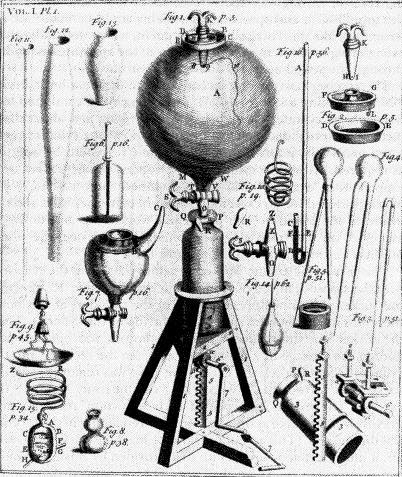
The Sceptical Chymist, which is excerpted below, is a long dialogue concerning the nature and number of the elements. Boyle does not know how many elements there are or what those elements may be; however, he argues that those who believe the elements to be earth, air, fire, and water (following Aristotle and the ancients) or mercury, sulfur, and salt (following more recent alchemical doctrine) do so on an insufficient basis. The cast of characters includes Carneades (representing Boyle's opinions), Themistius (representing the four-element system of the ancients), Philoponus (representing the three-principle system of the alchemists), and Eleutherius (an interested observer).
from The Sceptical Chymist, London, 1661
PHYSIOLOGICAL[1] CONSIDERATIONS Touching The experiments wont to be employed to evince either the IV Peripatetick Elements[2], or the III Chymical Principles[3] of Mixt Bodies[4] {#physiological1-considerations-touching-the-experiments-wont-to-be-employed-to-evince-either-the-iv-peripatetick-elements2-or-the-iii-chymical-principles3-of-mixt-bodies4 align="CENTER"}
Part of the First Dialogue.[5]
...
[pp. 13-17]
Philoponus and Themistius soon returned this complement with civilities of the like nature, in which Eleutherius perceiving them engaged, to prevent the further loss of that time of which they were not like to have very much to spare, he minded them that their present businesse was not to exchange complements, but Arguments: and then addressing his speech to Carneades, I esteem it no small happinesse (saies he) that I am come here so luckily this Evening.[6] For I have been long disquieted with Doubts concerning this very subject which you are now ready to debate. And since a Question of this importance is to be now discussed by persons that maintain such variety of opinions concerning it, and are both so able to enquire after truth, and so ready to embrace it by whomsoever and on what occasion soever it is presented them; I cannot but promise my self that I shall before we part either lose my Doubts or the hopes of ever finding them resolved: Eleutherius paused not here; but to prevent their answer, added almost in the same breath[7]; and I am not a little pleased to find that you are resolved on this occasion to insist rather on Experiments than Syllogismes.[8] For I, and no doubt You, have long observed, that those Dialectical subtleties, that the Schoolmen too often employ about Physiological Mysteries, are wont much more to declare the wit of him that uses them, then increase the knowledge or remove the doubts of sober lovers of truth. And such captious subtleties do indeed often puzzle and sometimes silence men, but rarely satisfy them. Being like the tricks of Jugglers, whereby men doubt not but they are cheated, though oftentimes they cannot declare by what flights they are imposed on. And therefore I think you have done very wisely to make it your businesse to consider the Phaenomena relating to the present Question, which have been afforded by experiments, especially since it might seem injurious to our senses, by whose mediation we acquire so much of the knowledge we have of things corporal, to have recourse to far-fetched and abstracted Ratiocination, to know what are the sensible ingredients of those sensible things that we daily see and handle, and are supposed to have the liberty to untwist (if I may so speak) into the primitive bodies they consist of. He annexed that he wished therefore they would no longer delay his expected satisfaction, if they had not, as he feared they had, forgotten something preparatory to their debate; and that was to lay down what should be all along understood by the word Principle or Element. Carneades thank'd him for his admonition, but told him that they had not been unmindful of so requisite a thing. But that being Gentlemen and very far from the litigious humour of loving to wrangle about words or terms or notions as empty; they had before his coming in, readily agreed promiscuously to use when they pleased, Elements and Principles as terms equivalent: and to understand both by the one and the other, those primitive and simple Bodies of which the mixt ones are said to be composed, and into which they are ultimately resolved.[9] And upon the same account (he added) we agreed to discourse of the opinions to be debated, as we have found them maintained by the Generality of the assertors of the four Elements of the one party, and of those that receive the three Principles on the other, without tying our selves to enquire scrupulously what notion either Aristotle or Paracelsus[10], or this or that Interpreter, or follower of either of those great persons, framed of Elements or Principles; our design being to examine, not what these or those thought or taught, but what we find to be the obvious and most general opinion of those, who are willing to be accounted Favourers of the Peripatetick or Chymical Doctrine, concerning this subject.[11]
...
[pp. 347-352]
THE SCEPTICAL CHYMIST OR, A Paradoxical Appendix to the Foregoing Treatise. {#the-sceptical-chymist-or-a-paradoxical-appendix-to-the-foregoing-treatise. align="CENTER"}
The Sixth Part.
Here Carneades Having Dispach't what he Thought Requisite to oppose against what the Chymists are wont to alledge for Proof of their three Principles, Paus'd awhile, and look'd about him, to discover whether it were Time for him and his Friend to Rejoyne the Rest of the Company. But Eleutherius perceiving nothing yet to forbid Them to Prosecute their Discourse a little further, said to his Friend, (who had likewise taken Notice of the same thing) I halfe expected, Carneades, that after you had so freely declar'd Your doubting, whether there be any Determinate Number of Elements, You would have proceeded to question whether there be any Elements at all.[12] And I confess it will be a Trouble to me if You defeat me of my Expectation; especially since you see the leasure we have allow'd us may probably suffice to examine that Paradox; because you have so largly Deduc'd already many Things pertinent to it, that you need but intimate how you would have them Apply'd and what you would inferr from them.
Carneades having in Vain represented that their leasure could be but very short, that he had already prated very long, that he was unprepared to maintain so great and so invidious a Paradox, was at length prevail'd with to tell his Friend; Since, Eleutherius, you will have me Discourse Ex Tempore of the Paradox[13] you mention, I am content, (though more perhaps to express my Obedience, then my Opinion) to tell you that (supposing the Truth of Helmonts[14] and Paracelsus's Alkahestical[15] Experiments, if I may so call them) though it may seem extravagant, yet it is not absurd to doubt, whether, for ought has been prov'd, there be a necessity to admit any Elements, or Hypostatical[16] Principles, at all.
And, as formerly, so now, to avoid the needless trouble of Disputing severally with the Aristotelians and the Chymists, I will address my self to oppose them I have last nam'd, Because their Doctrine about the Elements is more applauded by the Moderns, as pretending highly to be grounded upon Experience.[17] And, to deal not only fairly but favourably with them, I will allow them to take in Earth and Water to their other Principles. Which I consent to, the rather that my Discourse may the better reach the Tenents of the Peripateticks; who cannot plead for any so probably as for those two Elements; that of fire above the Air being Generally by Judicious Men exploded as an Imaginary thing; And the Air not concurring to compose Mixt Bodies as one of their Elements, but only lodging in their pores, or Rather replenishing, by reason of its Weight and Fluidity, all those Cavities of bodies here below, whether compounded or not, that are big enough to admit it, and are not fill'd up with any grosser substance.[18]
And, to prevent mistakes, I must advertize You, that I now mean by Elements, as those Chymists that speak plainest do by their Principles, certain Primitive and Simple, or perfectly unmingled bodies; which not being made of any other bodies, or of one another, are the Ingredients of which all those call'd perfectly mixt Bodies are immediately compounded, and into which they are ultimately resolved: now whether there be any one such body to be constantly met with in all, and each, of those that are said to be Elemented bodies, is the thing I now question.[19]
By this State of the controversie you will, I suppose, Guess, that I need not be so absurd as to deny that there are such bodies as Earth, and Water, and Quicksilver, and Sulphur: But I look upon Earth and Water, as component parts of the Universe, or rather of the Terrestrial Globe, not of all mixt bodies. And though I will not peremptorily deny that there may sometimes either a running Mercury, or a Combustible Substance be obtain'd from a Mineral, or even a Metal; yet I need not Concede either of them to be an Element in the sence above declar'd;[20] as I shall have occasion to shew you by and by.
To give you then a brief account of the grounds I intend to proceed upon, I must tell you, that in matters of Philosophy, this seems to me a sufficient reason to doubt of a known and important proposition, that the Truth of it is not yet by any competent proof made to appear. And congruously herunto, if I shew that the grounds upon which men are perswaded that there are Elements are unable to satisfie a considering man, I suppose my doubts will appear rational.[21]
...
[pp. 427-36]
THE CONCLUSION.
These last Words of Carneades being soon after follow'd by a noise which seem'd to come from the place where the rest of the Company was, he took it for a warning, that it was time for him to conclude or break off his Discourse; and told his Friend; By this time I hope you see, Eleutherius, that if Helmonts Experiments be true, it is no absurdity to question whether that Doctrine be one[22], that doth not assert Any Elements in the sence before explain'd. But because that, as divers of my Arguments suppose the marvellous power of the Alkahest in the Analyzing of Bodies, so the Effects ascrib'd to that power are so unparallell'd and stupendious, that though I am not sure but that there may be such an Agent, yet little less than αυτοψια seems requisite to make a man sure there is. And consequently I leave it to you to judge, how farre those of my Arguments that are built upon Alkahestical Operations are weakened by that Liquors being Matchless; and shall therefore desire you not to think that I propose this Paradox that rejects all Elements, as an Opinion equally probable with the former part of my discourse. For by that, I hope, you are satisfied, that the Arguments wont to be brought by Chymists, to prove That all Bodies consist of either Three Principles, or Five, are far from being so strong as those that I have employ'd to prove, that there is not any certain and Determinate number of such Principles or Elements to be met with Universally in all mixt Bodies.[23] And I suppose I need not tell you, that these Anti-Chymical Paradoxes might have been manag'd more to their Advantage; but that having not confin'd my Curiosity to Chymical Experiments, I who am but a young Man, and younger Chymist, can yet be but slenderly furnished with them, in reference to so great and difficult a Task as you impos'd upon me; Besides that, to tell you the Truth, I durst not employ some even of the best Experiments I am acquainted with, because I must not yet disclose them; but however, I think I may presume that what I have hitherto Discoursed will induce you to think, that Chymists have been much more happy in finding Experiments than the Causes of them; or in assigning the Principles by which they may best be explain'd.[24] And indeed, when in the writings of Paracelsus I meet with such Phantastick and Un-intelligible Discourses as that Writer often puzzels and tyres his Reader with, father'd upon such excellent Experiments, as though he seldom clearly teaches, I often find he knew; me thinks the Chymists, in their searches after truth, are not unlike the Navigators of Solomons Tarshish Fleet, who brought home from their long and tedious Voyages, not only Gold, and Silver, and Ivory, but Apes and Peacocks too[25]; For so the Writings of several (for I say not, all) of your Hermetick Philosophers present us, together with divers Substantial and noble Experiments, Theories, which either like Peacocks feathers make a great shew, but are neither solid nor useful; or else like Apes, if they have some appearance of being rational, are blemish'd with some absurdity or other, that when they are Attentively consider'd, makes them appear Ridiculous.
Carneades having thus finish'd his Discourse against the received Doctrines of the Elements; Eleutherius judging he should not have time to say much to him before their separation, made some haste to tell him; I confess, Carneades, that you have said more in favour of your Paradoxes than I expected. For though divers of the Experiments you have mention'd are no secrets, and were not unknown to me, yet besides that you have added many of your own unto them, you have laid them together in such a way, and apply'd them to such purposes, and made such Deductions From them, as I have not Hitherto met with.[26]
But though I be therefore inclin'd to think, that Philoponus, had he heard you, would scarce have been able in all points to defend the Chymical Hypothesis against the arguments wherewith you have oppos'd it; yet me thinks that however your Objections seem to evince[27] a great part of what they pretend to, yet they evince it not all; and the numerous tryals of those you call the vulgar Chymists, may be allow'd to prove something too.
Wherefore, if it be granted you that you have made it probable,[28]
First, that the differing substances into which mixt Bodies are wont to be resolved by the Fire are not of a pure and an Elemenentary nature, especially for this Reason, that they yet retain so much of the nature of the Concrete[29] that afforded them, as to appear to be yet somewhat compounded, and oftentimes to differ in one Concrete from Principles of the same denomination in another:
Next, that as to the number of these differing substances, neither is it precisely three, because in most Vegetable and Animal bodies Earth and Phlegme are also to be found among their Ingredients; nor is there any one determinate number into which the Fire (as it is wont to be employ'd) does precisely and universally resolve all compound Bodies whatsoever, as well Minerals as others that are reputed perfectly mixt.
Lastly, that there are divers Qualities which cannot well be refer'd to any of these Substances, as if they primarily resided in it and belong'd to it; and some other qualities, which though they seem to have their chief and most ordinary residence in some one of these Principles or Elements of mixt Bodies, are not yet so deducible from it, but that also some more general Principles must be taken in to explicate them.[30]
If, I say, the Chymists (continues Eleutherius) be so Liberall as to make you these three Concessions, I hope you will, on your part, be so civil and Equitable as to grant them these three other propositions, namely;
First, that divers Mineral Bodies, and therefore probably all the rest, may be resolv'd into a Saline, a Sulphureous, and a Mercurial part; And that almost all Vegetable and Animal Concretes may, if not by the Fire alone, yet, by a skilfull Artist Employing the Fire as his chief Instrument, be divided into five differing Substances, Salt, Spirit, Oyle, Phlegme and Earth; of which the three former by reason of their being so much more Operative than the Two Later, deserve to be Lookt upon as the Three active Principles, and by way of Eminence to be call'd the three principles of mixt bodies.[31]
Next, that these Principles, Though they be not perfectly Devoid of all Mixture, yet may without inconvenience be stil'd the Elements of Compounded bodies, and bear the Names of those Substances which they most Resemble, and which are manifestly predominant in them; and that especially for this reason, that none of these Elements is Divisible by the Fire into Four or Five differing substances, like the Concrete whence it was separated.[32]
Lastly, That Divers of the Qualities of a mixt Body, and especially the Medical Virtues, do for the most part lodge in some One or Other of its principles, and may Therefore usefully be sought for in That Principle sever'd from the others.[33]
And in this also (pursues Eleutherius) methinks both you and the Chymists may easily agree, that the surest way is to Learn by particular Experiments, what differing parts particular Bodies do consist of, and by what wayes (either Actual or potential fire) they may best and most Conveniently be Separated, as without relying too much upon the Fire alone, for the resolving of Bodies,[34] so without fruitlessly contending to force them into more Elements than Nature made Them up of, or strip the sever'd Principles so naked, as by making Them Exquisitely Elementary to make them almost useless,[35]
These things (subjoynes Eleu.) I propose, without despairing to see them granted by you; not only because I know that you so much preferr the Reputation of Candor before that of subtility, that your having once suppos'd a truth would not hinder you from imbracing it when clearly made out to you; but because, upon the present occasion, it will be no disparagement to you to recede from some of your Paradoxes, since the nature and occasion of your past Discourse did not oblige you to declare your own opinions, but only to personate an Antagonist of the Chymists. So that (concludes he, with a smile) you may now by granting what I propose, add the Reputation of Loving the truth sincerely to that of having been able to oppose it subtilly.
Carneades's haste forbidding him to answer this crafty piece of flattery; Till I shal (sayes he) have an opportunity to acquaint you with my own Opinions about the controversies I have been discoursing of, you will not, I hope, expect I should declare my own sence of the Arguments I have employ'd. Wherefore I shall only tell you thus much at present; that though not only an acute Naturalist, but even I my self could take plausible Exceptions at some of them; yet divers of them too are such as will not perhaps be readily answer'd, and will Reduce my Adversaries, at least, to alter and Reform their Hypothesis. I perceive I need not minde you that the Objections I made against the Quaternary of Elements and Ternary of Principles needed not to be oppos'd so much against the Doctrines Themselves (either of which, especially the latter, may be much more probably maintain'd than hitherto it seems to have been, by those Writers for it I have met with) as against the unaccurateness and the unconcludingness of the Analytical Experiments vulgarly Relyed On to Demonstrate them.[36]
And therefore, if either of the two examin'd Opinions, or any other Theory of Elements, shall upon rational and Experimental grounds be clearly made out to me; 'Tis Obliging, but not irrational, in you to Expect, that I shall not be so farr in Love with my Disquieting Doubts, as not to be content to change them for undoubted truths. And (concludes Carneades smiling) it were no great disparagement for a Sceptick to confesse to you, that as unsatisfy'd as the past discourse may have made you think me with Doctrines of the Peripateticks, and the Chymists, about the Elements and Principles, I can yet so little discover what to acquiesce in, that perchance the Enquiries of others have scarce been more unsatisfactory to me, than my own have been to my self.[37]
FINIS.
Notes
[[1]]{#foot1}Here physiological means "relating to the material universe or to natural science, phyiscal" rather than "relating to the functions and properties of living bodies" [Oxford 1971].
[[2]]{#foot2}Peripatetic refers to Aristotle's school of philosophy. Aristotle believed in four elements: earth, air, fire, and water. (See previous chapter.)
[[3]]{#foot3}A modern writer would use alchemical in many places where Boyle uses chymical. According to the alchemist Paracelsus (see note 10 below) and his followers, there were three elements, or as they called them, principles: sulfur, mercury, and salt. Sulfur was associated with combustible substances, mercury with metals, and salt with fixity.
[[4]]{#foot4}The term mixed bodies encompasses both relatively pure chemical compounds and complicated composites of such compounds. Compounds are materials homogeneous on an atomic scale formed by the intimate bonding of elements in definite proportions. Minerals are examples of relatively pure compounds which were chemically analyzed in Boyle's time. Homogeneous mixtures such as the gases which comprise air or a solution of sugar in water also involve mixing of elements on a microscopic scale, but no chemical bonding. Biological substances such as meat (animal muscle) or plant tissue are examples of still more complicated composites, which were also subjected to chemical analysis.
[[5]]{#foot5}The dialogue is not the usual genre for scientific communication. The usual form employs detailed description of experimental procedures and observations. Boyle used this style as well, and in some ways helped set standards for it [Conant 1957]. Boyle, however, had ample precedent in his day for the dialogue form. Plato's dialogues set the precedent for the genre in philosophy, and science in the 17[^th^]{.underline} century was essentially a branch of philosophy (natural philosophy). Galileo's dialogues are perhaps the best known in science [Galilei 1632, Galilei 1634]. The Sceptical Chymist was not the last dialogue on chemical subjects: for example, Humphry Davy wrote some [Davy 1840]. Modern dialogues concerning science self-consciously allude to earlier examples (for example, Bronowski 1956).
[[6]]{#foot6}To the reader who is accustomed to the direct narrative of modern scientific communication, The Sceptical Chymist presents several challenges besides the dialogue form. The prose style of the time was flowery and complex. Boyle makes a point of employing a friendly dialogue so as to allow the clashing of ideas without the harsh polemics which often crept into learned treatises. As a result, there are many exchanges of compliments and civilities. The sentence structure imitates classical Latin models in deploying multiple subordinate clauses. The modern reader must also contend with unfamiliar words as well as familiar words with unfamiliar spellings, as with any text from Restoration England (e.g., complement for compliment). An attentive reader will also notice unfamiliar and unsystematic patterns of capitalization. Readers of editions that date back to Boyle or of facsimile editions would also notice a character resembling "f" used for lower-case "s" except at the end of a word.
[[7]]{#foot7}Eleutherius wishes to develop an informed opinion concerning the elements. He plays the part of an active student, moving the discussion along and keeping the other participants on task.
[[8]]{#foot8}What evidence will be allowed in this discussion? Whatever the conclusion, it is to be supported by empirical evidence, not rationalistic argument (e.g., syllogisms). This is an important point, for Aristotle's arguments were mainly rationalistic. (See previous chapter.) And even though the Alchemical principles claim to be based on empirical evidence, Carneades will show deficiencies in the interpretation of experiments on which the alchemical system is based.
[[9]]{#foot9}Before debating the nature and number of the elements, it is important to define what is meant by element. The participants in the debate will agree to treat the terms element and principle as interchangeable. (The Peripatetics usually used "element," and this term is the one in current usage; the alchemists used "principle.") An element is a simple substance, a building block for more complex substances. Complex bodies are formed from elements, and can be resolved into those elements by analysis.
This definition is a bit more restrictive than that proposed by Lavoisier in the late 18[^th^]{.underline} century (See next chapter.), for it implies not only that elements cannot be broken down into simpler substances, but also that they combine with each other to form complex substances. (See note 18 below.) Tenney Davis notes that the definition of element is not a subject of dispute in The Sceptical Chymist, and argues that it was already widely accepted in Boyle's time [Davis 1931]. Indeed, even Aristotle gave a definition remarkably like Boyle's [Aristotle Caelo]: "An element, we take it, is a body into which other bodies may be analysed, present in them potentially or in actuality (which of these, is still disputable), and not itself divisible into bodies different in form."
[[10]]{#foot10}Paracelsus (1493-1541; view portraits in Jack Lynch's site, University of Pennsylvania), also known as Theophrastus von Hohenheim, was a physician who rejected many of the tenets of classical medicine. Among his innovations was the application of chemical substances to treat medical conditions (such as mercury to treat syphillis). His alchemical writings, like many of the time, contain a mixture of mysticism and experiment.
[[11]]{#foot11}The debate will not be historical, about who said what about the elements and when. It will examine the version of the Peripatetic and alchemical systems of elements as commonly taught and understood in Boyle's time.
[[12]]{#foot12}By this point in the dialogue, Carneades has raised doubts about the Peripatetic and alchemical beliefs on the elements, criticizing the evidence on which those beliefs were grounded. He has been so successful in raising doubts that Eleutherius wonders whether there is good reason to believe elements exist at all.
[[13]]{#foot13}One of the meanings of paradox current in Boyle's time but rare since the 17[^th^]{.underline} century was "a statement or tenet contrary to received opinion or belief" [Oxford 1971]. A paradox, then, need not be or seem self-contradictory. The paradox to which Carneades refers is the doubt whether there are such things as elements. He will proceed to defend this skepticism, or at least to show it is plausible ("not absurd").
[[14]]{#foot14}van Helmont (1580-1644; view portrait at National Library of Medicine) was a transitional figure between alchemy and chemistry, combining belief in the philosopher's stone with careful observation and experimentation. He believed water was the primary element. In support of this belief, he observed that a tree planted in a measured amount of soil to which nothing but water had been added increased in weight well over 100 pounds while the soil lost only a few ounces.
[[15]]{#foot15}Alkahest is a term invented by Paracelsus to denote a universal solvent. The context suggests that Carneades refers to experiments of chemical analysis, in which a complex body is broken down into its simpler substances.
[[16]]{#foot16}Here hypostatical means "of or pertaining to the essential principles or elements of bodies; elemental" [Oxford 1971].
[[17]]{#foot17}The Peripatetic set of four elements and its rationalistic basis was already falling out of favor. Carneades will focus his doubts on the existence of elements on the most plausible proposed elements, namely those of the alchemists plus water and earth (the more plausible of the Peripatetic set). He dispenses with fire and air in just a couple of sentences.
[[18]]{#foot18}Note why Carneades does not consider air to be an element. He does not argue that air is itself a compound or mixed body, capable of being broken down into simpler material. Rather, he says air does not enter into combination with other substances to give rise to compound bodies; air is not a building block of compounds. Had 19[^th^]{.underline}-century scientists followed Boyle's definition of an element rather than Lavoisier's similar but not identical formulation, they would not have considered argon and its related noble gases to be elements. (See chapter 14.)
[[19]]{#foot19}The question to which Carneades addresses himself is whether there is any element found in all "Elemented bodies" (i.e., compound bodies, for elemented means "composed of elements," not "elementary"). The notion of being a component of all compounds is certainly no longer part of the idea of element. It appears to be a remnant from the Aristotelian conception in which complex bodies were formed of all four elements, actually or potentially present to various degrees; it is not explicit in the definition which forms the first part of this paragraph or in the definition given near the beginning of the treatise (see note 9).
[[20]]{#foot20}Of course substances such as water and sulfur exist. These substances even result from analysis of some minerals and metals. But they do not seem to be ingredients of all complex materials.
[[21]]{#foot21}Carneades intends only to show that his doubts are reasonable. His standard for establishing an idea in science appears to be similar to that required to convict in an American criminal trial: evidence which overcomes reasonable doubt.
[[22]]{#foot22}I.e., an absurdity. Carneades cleverly (if confusingly) says that if van Helmont is right, then elements do exist. But the evidence which would lead to this conclsion depends on the existence of the Alkahest, a dubious proposition in itself. The Alkahest is supposed to have such unusual powers that little short of seeing it for oneself (αυτοψια) would be convincing.
[[23]]{#foot23}Carneades' opinion on whether any elements exist can be termed agnostic; he seems to be saying here that there are no convincing arguments either for or against. This is in contrast to his stronger skepticism concerning the notion that there is a set number of elements (such as the four of the ancients or the three of the alchemists).
[[24]]{#foot24}The alchemists, Carneades says, performed some good experiments. Their interpretations of experiment, however, left much to be desired. The alchemists were like modern scientists in that they performed experiments and made observations; they were, by and large, unlike modern scientists in trying to make connections between the observable but mysterious chemical changes and the unobservable mysteries of a preconceived philosophical system. Experiments were not so much means by which the natural world could be understood as tangible connections to deeper mysteries.
[[25]]{#foot25}I Kings 10:22. Boyle no doubt alludes to the King James version; more recent translations substitute monkeys for peacocks. At any rate, it is interesting to see Boyle draw a distinction between the presumably valuable minerals and the showy or ridiculous animals which is absent in the original, for in Kings the entire list is meant to convey the wealth of Solomon.
[[26]]{#foot26}In effect, Eleutherius makes the point that reliable science does not consist simply of gathering facts, for the facts alone do not speak for themselves. Indeed Carneades has just made a similar point, approving of the experiments of the alchemists but finding fault with their interpretations. Here Eleutherius compliments Carneades for arranging the experiments in such a way as to be able to draw some meaningful conclusion from them.
[[27]]{#foot27}Here evince means "confute, convict of error" [Oxford 1971]. Thus Eleutherius suggests that Carneades has successfully argued that the experiments of the alchemists do not prove what they purport to prove, but has not shown them to be completely worthless.
[[28]]{#foot28}Eleutherius is about to distill several working hypotheses out of the preceding discussion. Note that he characterizes the propositions as "probable," not as established. The standard of evidence required to consider a proposition as established is, as noted above (note 21), quite high. It is not necessary, however, for scientists to suspend belief completely in the absence of such evidence. It is often useful to hold propositions such as the following as working hypotheses, probable but provisional. It is fair to say that these propositions were useful in pursuing chemical analysis experimentally, but that they are largely irrelevant to the much more detailed and developed analytical methods used today.
[[29]]{#foot29}Here concrete carries the connotation of composite much more strongly than the connotations of tangible or solid which are more common in modern usage. Thus a concrete is a compound body. Eleutherius suggests that what results when such bodies are broken down by fire are not themselves pure substances and therefore not elements.
[[30]]{#foot30}Perhaps Boyle is referring to such qualities as combustibility (commonly associated with sulfur) or fixity (commonly associated with salt). Some modern commentators are inclined to consider the alchemical principles (or the ancient elements for that matter) not as literal substances but as abstractions of qualities such as as these. (See, for example, Partington 1948.) Boyle, however, seems to say that these qualities are not perfectly embodied in any one substance, at least not in any substance which results from chemical analysis.
[[31]]{#foot31}Eleutherius summarizes the common features of analysis of several classes of materials, namely animal, vegetable, and mineral. The minerals (or inorganic substances) seem to be broken down into something like salt, sulfur, and mercury. The animal and vegetable (or organic) substances seem to be more complicated, yielding more substances upon analysis. The main components of organic materials seem to be salt, something volatile (i.e., readily evaporated, namely the "spirit"), and oil.
[[32]]{#foot32}Even though the results of the chemical analyses of the time are not exactly pure substances, still they are not as complicated as the composite bodies before analysis. So salt, earth, and the like may not be elementary, but it is useful to think of them as components of composite bodies.
[[33]]{#foot33}This is an interesting insight. Put in more modern terms, it says that medical activity in a composite substance is due to one of its components; therefore, administering only the active component would be a more effective treatment than administering the whole substance. Medically active components, however, tend to be chemical compounds, not elements; so the separation involved here is one of a composite body into its compounds, not a compound into its elements.
[[34]]{#foot34}Eleutherius suggests that the development of better analytical tools will be required before the question of elements can be resolved empirically; fire is simply too blunt an instrument. He was quite right on this score: improvements in the techniques of analytical chemistry markedly assisted the development of the science of chemistry, for new techniques often yielded new or more detailed information on chemical topics including the identification of elements.
[[35]]{#foot35}This speculation that it may be possible to break down substances so far as to be "useless" has been borne out by developments in the 20[^th^]{.underline} century. The chemical elements recognized today are "elementary" for chemical purposes in that they persist in a recognizable form in chemical processes. But those elements can be broken down further into components, such as protons, neutrons, and electrons. This further analysis turned out to be enormously valuable in providing insight into chemical questions. (For instance, what distinguishes one element from another is the number of protons in its nucleus, and what happens in chemical reactions involves mainly the rearrangement of electrons.) Protons and neutrons are themselves composite particles; however, their structure, though important to the physical understanding of matter, is unlikely to have any applications to chemistry.
[[36]]{#foot36}In sum, Carneades believes that it is necessary to clear away faulty or unreliable chemical ideas before building a reliable system on a firm empirical foundation.
[[37]]{#foot37}So the dialogue concludes with the skeptical Carneades vowing to keep an open mind, and refusing to tip his (or Boyle's) hand on whether elements even exist or how probable he thinks Eleutherius' propositions.
References
- Aristotle, De Caelo, translated by J. L. Stocks as On the Heavens in W. D. Ross, ed., The Works of Aristotle, vol. 2 (Oxford: Oxford, 1930)
- Robert Boyle, A Defence of the Doctrine Touching the Spring and Weight of the Air, London, 1662
- Robert Boyle, The Sceptical Chymist, London, 1661; annotated excerpts above.
- Robert Boyle, Tracts Written by the Honourable Robert Boyle, Containing New Experiments, Touching the Relation Between Flame and Air, London, 1672.
- Jacob Bronowski, "The Abacus and the Rose: A New Dialogue on Two World Systems" in Science and Human Values (New York: Harper and Row, 1956)
- James Bryant Conant, "Robert Boyle's Experiments in Pneumatics" in James Bryant Conant, ed., Harvard Case Histories in Experimental Science, Vol. 1, (Cambridge, MA: Harvard, 1957), pp. 1-63.
- Tenney L. Davis, "Boyle's conception of Element compared with that of Lavoisier," Isis 16, 82-91 (1931)
- Humphry Davy, The Collected Works of Humphry Davy, John Davy, Ed. (London: Smith, Elder, & Co., 1840), vol. 9, pp. 383-8.
- Galileo Galilei, Dialogue Concerning the Two Chief World Systems--Ptolemaic and Copernican (1632)
- Galileo Galilei, Dialogues Concerning Two New Sciences (1634)
- Oxford English Dictionary (Oxford: Oxford, 1971)
- J. R. Partington, "The Concepts of Substance and Chemical Element," Chymia 1, 109-21 (1948)
Back to the table of contents of Elements
and Atoms.
Back to the top of Classic Chemistry.\
Elements and Atoms: Chapter 3 Lavoisier's Elements of Chemistry
Antoine-Laurent Lavoisier (1743-1794) has been called the founder of modern chemistry. (View a portrait of Mme. & M. Lavoisier by Jacque-Louis David at the Metropolitan Museum of Art, New York.) Among his important contributions were the application of the balance and the principle of conservation of mass to chemistry, the explanation of combustion and respiration in terms of combination with oxygen rather than loss of phlogiston (See chapter 5.), and a reform of chemical nomenclature. His Traité Élementaire de Chimie (1789), from which the present extract is taken in a contemporary translation, was a tremendously influential synthesis of his work.
Lavoisier was a public servant as well as a scientist. Under the French monarchy, he was a member of the tax-collecting agency, the Ferme Générale. His work for the government included advocating rational agricultural methods and improving the manufacture of gunpowder. His service to France continued during the Revolution. He was an alternate deputy of the reconvened Estates-General in 1789, and from 1790 served on a commission charged with making weights and measures uniform across France. A Parisian by birth, Lavoisier also died in Paris, guillotined with other former members of the Ferme Générale during the Reign of Terror in May 1794.
The preface to his Traité Élementaire de Chimie is a fitting selection to follow Boyle's The Sceptical Chymist because it includes the definition of element that was to dominate chemistry throughout the next century, and which is still familiar in our own day. In addition, Lavoisier's musings on the connection between science and the language which conveys its ideas remain thought-provoking, particularly in light of the writings of Bertrand Russell, Ludwig Wittgenstein, and Alfred Ayer in the first half of the 20[^th^]{.underline} century. Even his comments about the pedagogy of introductory chemistry take sides in a debate that remains current.
Antoine Lavoisier, Preface to Elements of Chemistry
translation by Robert Kerr (Edinburgh, 1790), pp. xiii-xxxvii
When I began the following Work, my only object was to extend and explain more fully the Memoir which I read at the public meeting of the Academy of Science in the month of April 1787, on the necessity of reforming and completing the Nomenclature of Chemistry[1]. While engaged in this employment, I perceived, better than I had ever done before, the justice of the following maxims of the Abbé de Condillac[2], in his System of Logic, and some other of his works.
"We think only through the medium of words. --Languages are true analytical methods. --Algebra, which is adapted to its purpose in every species of expression, in the most simple, most exact, and best manner possible, is at the same time a language and an analytical method. --The art of reasoning is nothing more than a language well arranged."
Thus, while I thought myself employed only in forming a Nomenclature, and while I proposed to myself nothing more than to improve the chemical language, my work transformed itself by degrees, without my being able to prevent it, into a treatise upon the Elements of Chemistry.
The impossibility of separating the nomenclature of a science from the science itself, is owing to this, that every branch of physical science must consist of three things; the series of facts which are the objects of the science, the ideas which represent these facts, and the words by which these ideas are expressed. Like three impressions of the same seal, the word ought to produce the idea, and the idea to be a picture of the fact. And, as ideas are preserved and communicated by means of words, it necessarily follows that we cannot improve the language of any science without at the same time improving the science itself; neither can we, on the other hand, improve a science, without improving the language or nomenclature which belongs to it. However certain the facts of any science may be, and, however just the ideas we may have formed of these facts, we can only communicate false impressions to others, while we want words by which these may be properly expressed.[3]
To those who will consider it with attention, the first part of this treatise will afford frequent proofs of the truth of the above observations. But as, in the conduct of my work, I have been obliged to observe an order of arrangement essentially differing from what has been adopted in any other chemical work yet published, it is proper that I should explain the motives which have led me to do so.
It is a maxim universally admitted in geometry, and indeed in every branch of knowledge, that, in the progress of investigation, we should proceed from known facts to what is unknown. In early infancy, our ideas spring from our wants; the sensation of want excites the idea of the object by which it is to be gratified. In this manner, from a series of sensations, observations, and analyses, a successive train of ideas arises, so linked together, that an attentive observer may trace back to a certain point the order and connection of the whole sum of human knowledge.
When we begin the study of any science, we are in a situation, respecting that science, similar to that of children; and the course by which we have to advance is precisely the same which Nature follows in the formation of their ideas. In a child, the idea is merely an effect produced by a sensation; and, in the same manner, in commencing the study of a physical science, we ought to form no idea but what is a necessary consequence, and immediate effect, of an experiment or observation.[4] Besides, he that enters upon the career of science, is in a less advantageous situation than a child who is acquiring his first ideas. To the child, Nature gives various means of rectifying any mistakes he may commit respecting the salutary or hurtful qualities of the objects which surround him. On every occasion his judgments are corrected by experience; want and pain are the necessary consequences arising from false judgment; gratification and pleasure are produced by judging aright. Under such masters, we cannot fail to become well informed; and we soon learn to reason justly, when want and pain are the necessary consequences of a contrary conduct.[5]
In the study and practice of the sciences it is quite different; the false judgments we form neither affect our existence nor our welfare; and we are not forced by any physical necessity to correct them. Imagination, on the contrary, which is ever wandering beyond the bounds of truth, joined to self-love and that self-confidence we are so apt to indulge, prompt us to draw conclusions which are not immediately derived from facts; so that we become in some measure interested in deceiving ourselves. Hence it is by no means to be wondered, that, in the science of physics in general, men have often made suppositions, instead of forming conclusions. These suppositions, handed down from one age to another, acquire additional weight from the authorities by which they are supported, till at last they are received, even by men of genius, as fundamental truths.
The only method of preventing such errors from taking place, and of correcting them when formed, is to restrain and simplify our reasoning as much as possible. This depends entirely upon ourselves, and the neglect of it is the only source of our mistakes. We must trust to nothing but facts: These are presented to us by Nature, and cannot deceive. We ought, in every instance, to submit our reasoning to the test of experiment, and never to search for truth but by the natural road of experiment and observation. Thus mathematicians obtain the solution of a problem by the mere arrangement of data, and by reducing their reasoning to such simple steps, to conclusions so very obvious, as never to lose sight of the evidence which guides them.[6]
Thoroughly convinced of these truths, I have imposed upon myself, as a law, never to advance but from what is known to what is unknown; never to form any conclusion which is not an immediate consequence necessarily flowing from observation and experiment; and always to arrange the fact, and the conclusions which are drawn from them, in such an order as shall render it most easy for beginners in the study of chemistry thoroughly to understand them. Hence I have been obliged to depart from the usual order of courses of lectures and of treatises upon chemistry, which always assume the first principles of the science, as known, when the pupil or the reader should never be supposed to know them till they have been explained in subsequent lessons. In almost every instance, these begin by treating of the elements of matter, and by explaining the table of affinities[7], without considering, that, in so doing, they must bring the principal phenomena of chemistry into view at the very outset: They make use of terms which have not been defined, and suppose the science to be understood by the very persons they are only beginning to teach.[8] It ought likewise to be considered, that very little of chemistry can be learned in a first course, which is hardly sufficient to make the language of the science familiar to the ears, or the apparatus familiar to the eyes. It is almost impossible to become a chemist in less than three or four years of constant application.
These inconveniencies are occasioned not so much by the nature of the subject, as by the method of teaching it; and, to avoid them, I was chiefly induced to adopt a new arrangement of chemistry, which appeared to me more consonant to the order of Nature. I acknowledge, however, that in thus endeavouring to avoid difficulties of one kind, I have found myself involved in others of a different species, some of which I have not been able to remove; but I am persuaded, that such as remain do not arise from the nature of the order I have adopted, but are rather consequences of the imperfection under which chemistry still labours. This science still has many chasms, which interrupt the series of facts, and often render it extremely difficult to reconcile them with each other: It has not, like the elements of geometry, the advantage of being a complete science, the parts of which are all closely connected together: Its actual progress, however, is so rapid, and the facts, under the modern doctrine, have assumed so happy an arrangement, that we have ground to hope, even in our own times, to see it approach near to the highest state of perfection of which it is susceptible.[9]
The rigorous law from which I have never deviated, of forming no conclusions which are not fully warranted by experiment, and of never supplying the absence of facts, has prevented me from comprehending in this work the branch of chemistry which treats of affinities, although it is perhaps the best calculated of any part of chemistry for being reduced into a completely systematic body. Messrs Geoffroy, Gellert, Bergman, Scheele, De Morveau, Kirwan,[10] and many others, have collected a number of particular facts upon this subject, which only wait for a proper arrangement; but the principal data are still wanting, or, at least, those we have are either not sufficiently defined, or not sufficiently proved, to become the foundation upon which to build so very important a branch of chemistry. This science of affinities, or elective attractions, holds the same place with regard to the other branches of chemistry, as the higher or transcendental geometry does with respect to the simpler and elementary part; and I thought it improper to involve those simple and plain elements, which I flatter myself the greatest part of my readers will easily understand, in the obscurities and difficulties which still attend that other very useful and necessary branch of chemical science.
Perhaps a sentiment of self-love may, without my perceiving it, have given additional force to these reflections. Mr de Morveau is at present engaged in publishing the article Affinity in the Methodical Encyclopedia; and I had more reasons than one to decline entering upon a work in which he is employed.
It will, no doubt, be a matter of surprise, that in a treatise upon the elements of chemistry, there should be no chapter on the constituent and elementary parts of matter; but I shall take occasion, in this place, to remark, that the fondness for reducing all the bodies in nature to three or four elements, proceeds from a prejudice which has descended to us from the Greek Philosophers. The notion of four elements, which, by the variety of their proportions, compose all the known substances in nature, is a mere hypothesis, assumed long before the first principles of experimental philosophy or of chemistry had any existence. In those days, without possessing facts, they framed systems; while we, who have collected facts, seem determined to reject them, when they do not agree with our prejudices. The authority of these fathers of human philosophy still carry great weight, and there is reason to fear that it will even bear hard upon generations yet to come.[11]
It is very remarkable, that, notwithstanding of the number of philosophical chemists who have supported the doctrine of the four elements, there is not one who has not been led by the evidence of facts to admit a greater number of elements into their theory. The first chemists that wrote after the revival of letters, considered sulphur and salt as elementary substances entering into the composition of a great number of substances; hence, instead of four, they admitted the existence of six elements. Beccher assumes the existence of three kinds of earth, from the combination of which, in different proportions, he supposed all the varieties of metallic substances to be produced. Stahl gave a new modification to this system; and succeeding chemists have taken the liberty to make or to imagine changes and additions of a similar nature. All these chemists were carried along by the influence of the genius of the age in which they lived, which contented itself with assertions without proofs; or, at least, often admitted as proofs the slightest degrees of probability, unsupported by that strictly rigorous analysis required by modern philosophy.[12]
All that can be said upon the number and nature of elements is, in my opinion, confined to discussions entirely of a metaphysical nature. The subject only furnishes us with indefinite problems, which may be solved in a thousand different ways, not one of which, in all probability, is consistent with nature. I shall therefore only add upon this subject, that if, by the term elements, we mean to express those simple and indivisible atoms of which matter is composed, it is extremely probable we know nothing at all about them; but, if we apply the term elements, or principles of bodies, to express our idea of the last point which analysis is capable of reaching, we must admit, as elements, all the substances into which we are capable, by any means, to reduce bodies by decomposition.[13] Not that we are entitled to affirm, that these substances we consider as simple may not be compounded of two, or even of a greater number of principles; but, since these principles cannot be separated, or rather since we have not hitherto discovered the means of separating them, they act with regard to us as simple substances, and we ought never to suppose them compounded until experiment and observation has proved them to be so.[14]
The foregoing reflections upon the progress of chemical ideas naturally apply to the words by which these ideas are to be expressed. Guided by the work which, in the year 1787, Messrs de Morveau, Berthollet, de Fourcroy, and I composed upon the Nomenclature of Chemistry, I have endeavoured, as much as possible, to denominate simple bodies by simple terms, and I was naturally led to name these first.[15] It will be recollected, that we were obliged to retain that name of any substance by which it had been long known in the world, and that in two cases only we took the liberty of making alterations; first, in the case of those which were but newly discovered, and had not yet obtained names, or at least which had been known but for a short time, and the names of which had not yet received the sanction of the public; and, secondly, when the names which had been adopted, whether by the ancients or the moderns, appeared to us to express evidently false ideas, when they confounded the substances, to which they were applied, with others possessed of different, or perhaps opposite qualities. We made no scruple, in this case, of substituting other names in their room, and the greatest number of these were borrowed from the Greek language. We endeavoured to frame them in such a manner as to express the most general and the most characteristic quality of the substances; and this was attended with the additional advantage both of assisting the memory of beginners, who find it difficult to remember a new word which has no meaning, and of accustoming them early to admit no word without connecting with it some determinate idea.[16]
To those bodies which are formed by the union of several simple substances we gave new names, compounded in such a manner as the nature of the substances directed; but, as the number of double combinations is already very considerable, the only method by which we could avoid confusion, was to divide them into classes. In the natural order of ideas, the name of the class or genus is that which expresses a quality common to a great number of individuals: The name of the species, on the contrary, expresses a quality peculiar to certain individuals only.[17]
These distinctions are not, as some may imagine, merely metaphysical, but are established by Nature. "A child," says the Abbé de Condillac, "is taught to give the name tree to the first one which is pointed out to him. The next one he sees presents the same idea, and he gives it the same name. This he does likewise to a third and a fourth, till at last the word tree, which he first applied to an individual, comes to be employed by him as the name of a class or a genus, an abstract idea, which comprehends all trees in general. But, when he learns that all trees serve not the same purpose, that they do not all produce the same kind of fruit, he will soon learn to distinguish them by specific and particular names." This is the logic of all the sciences, and is naturally applied of chemistry.
The acids, for example, are compounded of two substances, of the order of those which we consider as simple; the one constitutes acidity, and is common to all acids, and, from this substance, the name of the class or the genus ought to be taken; the other is peculiar to each acid, and distinguishes it from the rest, and from this substance is to be taken the name of the species. But, in the greatest number of acids, the two constituent elements, the acidifying principle, and that which it acidifies, may exist in different proportions, constituting all the possible points of equilibrium or of saturation. This is the case in the sulphuric and the sulphurous acids; and these two states of the same acid we have marked by varying the termination of the specific name.
Metallic substances which have been exposed to the joint action of the air and of fire, lose their metallic lustre, increase in weight, and assume an earthy appearance. In this state, like the acids, they are compounded of a principle which is common to all, and one which is peculiar to each. In the same way, therefore, we have thought proper to class them under a generic name, derived from the common principle; for which purpose, we adopted the term oxyd; and we distinguish them from each other by the particular name of the metal to which each belongs.[18]
Combustible substances, which in acids and metallic oxyds are a specific and particular principle, are capable of becoming, in their turn, common principles of a great number of substances. The sulphurous combinations have been long the only known ones in this kind. Now, however, we know, from the experiments of Messrs Vandermonde, Monge, and Berthollet, that charcoal may be combined with iron, and perhaps with several other metals; and that, from this combination, according to the proportions, may be produced steel, plumbago, &c.[19] We know likewise, from the experiments of M. Pelletier, that phosphorus may be combined with a great number of metallic substances. These different combinations we have classed under generic names taken from the common substance, with a termination which marks this analogy, specifying them by another name taken from that substance which is proper to each.
The nomenclature of bodies compounded of three simple substances was attended with still greater difficulty, not only on account of their number, but, particularly, because we cannot express the nature of their constituent principles without employing more compound names. In the bodies which form this class, such as the neutral salts, for instance, we had to consider, 1st, The acidifying principle, which is common to them all; 2d, The acidifiable principle which constitutes their peculiar acid; 3d, The saline, earthy, or metallic basis, which determines the particular species of salt. Here we derived the name of each class of salts from the name of the acidifiable principle common to all the individuals of that class; and distinguished each species by the name of the saline, earthy, or metallic basis, which is peculiar to it.[20]
A salt, though compounded of the same three principles, may, nevertheless, by the mere difference of their proportion, be in three different states. The nomenclature we have adopted would have been defective, had it not expressed these different states; and this we attained chiefly by changes of termination uniformly applied to the same state of the different salts.
In short, we have advanced so far, that from the name alone may be instantly found what the combustible substance is which enters into any combination; whether that combustible substance be combined with the acidifying principle, and in what proportion; what is the state of the acid; with what basis it is united; whether the saturation be exact, or whether the acid or the basis be in excess.
It may be easily supposed that it was not possible to attain all these different objects without departing, in some instances, from established custom, and adopting terms which at first sight will appear uncouth and barbarous. But we considered that the ear is soon habituated to new words, especially when they are connected with a general and rational system. The names, besides, which were formerly employed, such as powder of algaroth, salt of alembroth, pompholix, phagadenic water, turbith mineral, colcothar, and many others, were neither less barbarous nor less uncommon.[21] It required a great deal of practice, and no small degree of memory, to recollect the substances to which they were applied, much more to recollect the genus of combination to which they belonged. The names of oil of tartar per deliquium, oil of vitriol, butter of arsenic and of antimony, flowers of zinc, &c. were still more improper, because they suggested false ideas: For, in the whole mineral kingdom, and particularly in the metallic class, there exists no such thing as butters, oils, or flowers; and, in short, the substances to which they give these fallacious names, are nothing less than rank poisons.[22]
When we published our essay on the nomenclature of chemistry, we were reproached for having changed the language which was spoken by our masters, which they distinguished by their authority, and handed down to us. But those who reproach us on this account, have forgotten that it was Bergman and Macquer themselves who urged us to make this reformation. In a letter which the learned Professor of Upsal, M. Bergman, wrote, a short time before he died, to M. de Morveau, he bids him spare no improper names; those who are learned, will always be learned, and those who are ignorant will thus learn sooner.[23]
There is an objection to the work which I am going to present to the public, which is perhaps better founded, that I have given no account of the opinion of those who have gone before me; that I have stated only my own opinion, without examining that of others. By this I have been prevented from doing that justice to my associates, and more especially to foreign chemists, which I wished to render them. But I beseech the reader to consider, that, if I had filled an elementary work with a multitude of quotations; if I had allowed myself to enter into long dissertations on the history of the science, and the works of those who have studied it, I must have lost sight of the true object I had in view, and produced a work, the reading of which must have been extremely tiresome to beginners. It is not to the history of the science, or of the human mind, that we are to attend in an elementary treatise:[24] Our only aim ought to be ease and perspicuity, and with the utmost care to keep every thing out of view which might draw aside the attention of the student; it is a road which we should be continually rendering more smooth, and from which we should endeavour to remove every obstacle which can occasion delay. The sciences, from their own nature, present a sufficient number of difficulties, though we add not those which are foreign to them. But, besides this, chemists will easily perceive, that, in the fist part of my work, I make very little use of any experiments but those which were made by myself: If at any time I have adopted, without acknowledgment, the experiments or the opinions of M. Berthollet, M. Fourcroy, M. de la Place, M. Monge, or, in general, of any of those whose principles are the same with my own, it is owing to the circumstance, that frequent intercourse, and the habit of communicating our ideas, our observations, and our way of thinking to each other, has established between us a sort of community of opinions, in which it is often difficult for every one to know his own.[25]
The remarks I have made on the order which I thought myself obliged to follow in the arrangement of proofs and ideas, are to be applied only to the first part of this work. It is the only one which contains the general sum of the doctrine I have adopted, and to which I wished to give a form completely elementary.[26]
The second part is composed chiefly of tables of the nomenclature of the neutral salts. To these I have only added general explanations, the object of which was to point out the most simple processes for obtaining the different kinds of known acids. This part contains nothing which I can call my own, and presents only a very short abridgment of the results of these processes, extracted from the works of different authors.
In the third part, I have given a description, in detail, of all the operations connected with modern chemistry. I have long thought that a work of this kind was much wanted, and I am convinced it will not be without use. The method of performing experiments, and particularly those of modern chemistry, is not so generally known as it ought to be; and had I, in the different memoirs which I have presented to the Academy, been more particular in the detail of the manipulations of my experiments, it is probable I should have made myself better understood, and the science might have made a more rapid progress. The order of the different matters contained in this third part appeared to me to be almost arbitrary; and the only one I have observed was to class together, in each of the chapters of which it is composed, those operations which are most connected with one another. I need hardly mention that this part could not be borrowed from any other work, and that, in the principal articles it contains, I could not derive assistance from any thing but the experiments which I have made myself.
I shall conclude this preface by transcribing, literally, some observations of the Abbé de Condillac, which I think describe, with a good deal of truth, the state of chemistry at a period not far distant from our own. These observations were made on a different subject; but they will not, on this account, have less force, if the application of them be thought just.[27]
"Instead of applying observation to the things we wished to know, we have chosen rather to imagine them. Advancing from one ill founded supposition to another, we have at last bewildered ourselves amidst a multitude of errors. These errors becoming prejudices, are, of course, adopted as principles, and we thus bewilder ourselves more and more. The method, too, by which we conduct our reasonings is as absurd; we abuse words which we do not understand, and call this the art of reasoning. When matters have been brought this length, when errors have been thus accumulated, there is but one remedy by which order can be restored to the faculty of thinking; this is, to forget all that we have learned, to trace back our ideas to their source, to follow the train in which they rise, and, as my Lord Bacon says, to frame the human understanding anew.
"This remedy becomes the more difficult in proportion as we think ourselves more learned. Might it not be thought that works which treated of the sciences with the utmost perspicuity, with great precision and order, must be understood by every body? The fact is, those who have never studied any thing will understand them better than those who have studied a great deal, and especially those who have written a great deal."
At the end of the fifth chapter, the Abbé de Condillac adds: "But, after all, the sciences have made progress, because philosophers have applied themselves with more attention to observe, and have communicated to their language that precision and accuracy which they have employed in their observations: In correcting their language they reason better."
[]{#lavtable}
Antoine Lavoisier, Table of Simple Substances in Elements of Chemistry
translation by Robert Kerr (Edinburgh, 1790), pp. 175-6
Simple substances belonging to all the kingdoms of nature, which may be considered as the elements of bodies.
New Names. Correspondent old Names.
Light[28] Light. Caloric Heat. Principle or element of heat. Fire. Igneous fluid. Matter of fire and of heat. Oxygen[29] Depholgisticated air. Empyreal air. Vital air, or Base of vital air. Azote[30] Phlogisticated air or gas. Mephitis, or its base. Hydrogen[31] Inflammable air or gas, or the base of inflammable air.
Oxydable[32] and Acidifiable simple Substances not Metallic.
New Names. Correspondent old names.
Sulphur The same names.
Phosphorus
Charcoal
Muriatic radical[33] Still unknown.
Fluoric radical
Boracic radical
Oxydable and Acidifiable simple Metallic Bodies.
New Names.
Correspondent Old Names.
Antimony
Antimony.
Arsenic
" "
Arsenic
Bismuth
" "
Bismuth
Cobalt
" "
Cobalt
Copper
" "
Copper
Gold
" "
Gold
Iron
" "
Iron
Lead
" "
Lead
Manganese
" "
Manganese
Mercury
" "
Mercury
Molybdena[35]
" "
Molybdena
Nickel
" "
Nickel
Platina
" "
Platina
Silver
" "
Silver
Tin
" "
Tin
Tungstein[36]
" "
Tungstein
Zinc
" "
Zinc
Salifiable simple Earthy Substances[37]
New Names. Correspondent Old Names.
Lime Chalk, calcareous earth. Quicklime. Magnesia Magnesia, base of Epsom salt. Calcined or caustic magnesia. Barytes Barytes, or heavy earth. Argill Clay, earth of alum. Silex Siliceous or vitrifiable earth.
Notes
[[1]]{#foot1}Lavoisier read "Méthode de Nomenclature Chimique" before the French Academy on 18 April 1787. This outline for a reformulation of chemical nomenclature was prepared by Lavoisier and three of his early converts to the oxygen theory of combustion, Louis Bernard Guyton de Morveau, Claude Louis Berthollet, and Antoine François de Fourcroy. De Morveau had already argued for a reformed nomenclature, and he developed the April 1787 outline in a memoir read to the Academy on 2 May 1787. [Leicester & Klickstein 1952]
[[2]]{#foot2}Étienne Bonnot de Condillac (1715-1780) was a French philosopher and associate of Rousseau, Diderot, and the Encyclopedists. His La Logique (1780) stressed the importance of language as a tool in scientific and logical reasoning.
[[3]]{#foot3}Lavoisier makes an excellent point, but he overstates it. Clearly ones ideas are not strictly limited or determined by one's language. New ideas must exist before new terms can be coined to express those ideas; thus new ideas can be formed and even to some extent described under the sway of older language. Also, new terms can only be defined by reference to pre-existing terms. Sometimes new terms are not necessary, as old terms absorb new meanings. For example, I hope that the selections in this book show to some extent how the terms "atom" and "element" have changed in meaning over time. Having made these points, I do not wish to minimize the ability of new terminology to help the mind to run along the path of new insights, or to prevent it from falling into old misconceptions.
[[4]]{#foot4}Note that Lavoisier does not say merely that we ought not believe any idea but what follows immediately and necessarily from experiment, we ought not even form the idea. This statement shows a wariness of hypotheses common to many early scientists and natural philosophers. Compare Newton's, "I frame no hypotheses; for ... hypotheses ... have no place in experimental philosophy." [in Bartlett 1980] Hypotheses had no part in the empirical methodology of Francis Bacon (1561-1626; see portrait at National Portrait Gallery, London), which emphasized collection and classification of facts. This aversion to hypotheses is too not surprising if one considers that empiricists were attempting to distance themselves from rationalism. Later formulations of the scientific method, however, acknowledge the utility of hypotheses, always treated as provisional, in both suggesting experiments and interpreting them.
[[5]]{#foot5}Lavoisier was not the last to observe that children are born scientists who learn by experience.
[[6]]{#foot6}Lavoisier's choice of mathematics as an example may strike a modern reader as odd. While mathematics has long served as an example of the kind of certainty to which scientists aspire ("mathematical certainty"), it is now seen as based on axioms, not empirically based. Such mathematical systems as non-Euclidean geometry, which seemed to disagree with observed reality, had not yet been constructed at the time of Lavoisier's writing, though.
[[7]]{#foot7}A table of affinities was a summary of a great deal of information on chemical reactions. It lists what substances react chemically with a given substance, often in order of the vigor or extent of the reaction. (If substance A reacted more strongly than substance B with a given material, then substance A was said to have a greater affinity than B for that material.) View a table of affinities by Étienne-François Geoffroy (1672-1731).
[[8]]{#foot8}In Lavoisier's mind, it makes no sense to jump to this summary table without first describing the various substances and their characteristic reactions. The proper role of descriptive chemistry in the chemical curriculum continues to be a topic of debate in chemical education. Apparently Lavoisier would be quite sympathetic to the charge that introductory courses emphasize unifying principles at the expense of descriptive chemistry.
[[9]]{#foot9}This is certainly an optimistic statement! Two hundred years later chemistry has developed to an extent Lavoisier could not have imagined, yet it is a rare and foolish chemist who expects the science to exhaust its possibilities for discovery within a lifetime.
[[10]]{#foot10}Bergman, Scheele, De Morveau, and Kirwan were all contemporaries of Lavoisier. The Swedish chemist Carl Wilhelm Scheele had a hand in the discovery of oxygen, chlorine, and manganese. The Swedish chemist and mineralogist Torbern Bergman made contributions to analytical chemistry and the classification of minerals. Richard Kirwan was an Irish chemist and a defender of the phlogiston theory.
[[11]]{#foot11}The influence of the ancients was on the decline when Lavoisier wrote these words, but he does not exaggerate the importance of their thought. Remember that he is still concerned about their influence more than a century after The Sceptical Chymist and more than two millennia after the death of Aristotle. (See chapters 1 and 2.) The simplicity of ancient ideas of matter would continue to have an influence on chemists well after Lavoisier's time, particularly as the number of chemical elements grew. (See chapter 10.)
[[12]]{#foot12}Johann Joachim Becher (1635-1682) and Georg Ernst Stahl (1660-1734) were the two men most closely associated with the phlogiston theory. Lavoisier was largely responsible for dislodging and discrediting the notion that combustion and respiration involved a loss of a subtle material called phlogiston. (See chapter 5.) Lavoisier makes light of their ideas here, but the theory, though incorrect, was not as nonsensical as it may now appear.
[[13]]{#foot13}Notice the pragmatism of Lavoisier's approach: he suggests, in essence, forgetting about the ultimate building blocks of matter. This was a prudent recommendation, for he had no way of addressing that subject empirically (which is why he dismisses it as metaphysical). He continues by suggesting that chemists turn their attention to what they can observe empirically, the ultimate products of chemical analysis. The definition of an element as a body which cannot be broken down further by chemical analysis is an operational one: as the techniques of chemical analysis improved, then substances scientists had any right to regard as elements could change.
At first, this definition of element appears to be similar to that of Boyle. (See chapter 2, note 9.) However, Boyle seemed not to consider elementary substances which were not components of all compound matter.
[[14]]{#foot14}Lavoisier's table of simple bodies, reproduced below the preface, follows this prescription approximately, but not exactly. (See note 33 below.)
[[15]]{#foot15}See note 34 below on names of metals.
[[16]]{#foot16}Thus, where possible the name of a chemical substance should not simply be an arbitrary word, but should give some information about the substance. This principle is particularly evident in the modern systematic nomenclature of organic compounds: the name enables one who knows the rules of nomenclature and some organic chemistry to draw the structural formula of a compound from its name. (See IUPAC 1979, 1993.) The principle is also evident in the nomenclature of inorganic compounds [IUPAC 1971], the class of compounds Lavoisier's nomenclature primarily addresses. It is least evident in modern names of the elements, many of which are named after important scientists (e.g. curium, mendelevium, rutherfordium) or places important to the discoverers (e.g. polonium). (See Ringnes 1989 for etymology of elements' names.) Ironically, Lavoisier coined the name for an element central to his contributions to chemistry, a name of Greek origin chosen to convey information about the element which turned out to be incorrect. The name "oxygen" means "acid former," for Lavoisier believed that oxygen was a component of all acids.
[[17]]{#foot17}Already we see the close connection Lavoisier envisioned between the language of chemistry and the content of the science. The system of naming compounds depends on classifying those compounds. Compounds belonging to the same class would have similar names. The name would also reflect the chemical composition of the substance.
[[18]]{#foot18}So the classes of compounds included acids, oxides, sulfides, and the like. To specify which acid, a particular name was added, e.g. nitrous acid. Different suffixes distinguished between similar particular names (such as sulfuric and sulfurous--the -ic suffix applying to the more highly oxidized form).
[[19]]{#foot19}What Lavoisier has in mind is a class of materials now called carbides, inorganic compounds of a metal and carbon ("charcoal"). But the examples he gives are not carbides. Steel is an alloy (a mixture or solution of metals, and therefore not a chemical compound of definite proportions); in particular, steel is principally iron with some carbon and sometimes other metals (such as chromium or manganese). Although plumbago has been used to refer to a variety of lead-containing substances (as might be guessed from the root plumb-), it also (as here) refers to the substance now called graphite, the form of carbon commonly used for pencil "leads."
[[20]]{#foot20}Again in the case of salts we see the nomenclature embodying the principles of the chemical theory of the day. A salt was seen as a compound of an acid and a base, and an acid itself a compound of an acidifiable part and an acidifying part. The acidifying part, whatever its nature, was believed to be common to all acids; since it would not distinguish one salt from another, it does not appear in the name of the salt. The salts, then, carry the name of the acidifiable piece and the base with which it combines.
[[21]]{#foot21}Pompholix was a crude (i.e., not very pure) zinc oxide (ZnO), sometimes known by the more pleasant but hardly more informative name flowers of zinc. Phagadenic water was a corrosive liquid used to cleanse ulcers; phagadenic refers to a spreading or "eating" ulcer. Colcothar is a brownish-red mixture containing primarily ferric oxide (Fe2O3) with some calcium sulfate (CaSO4). [Oxford 1971]
[[22]]{#foot22}Oil of vitriol is sulfuric acid, a viscous liquid. Butter of arsenic (arsenic trichloride) is an oily liquid; and butter of antimony (antimony trichloride) is a colorless deliquescent solid. In one sense, these names are informative, for they suggest the physical appearance of the substances they name; they are, however, also misleading in the sense Lavoisier points out.
[[23]]{#foot23}Lavoisier recognizes that even the most rationally designed nomenclature would be useless if chemists chose not to use it. A language is one of the most visible signs of a people and culture; naturally, efforts to tamper with it can meet with disapproval. Thus Lavoisier pays at least nominal attention to aesthetic and cultural considerations, noting just above that the new terms sound no more "barbarous" than some technical terms then in existence. In a similar vein, he makes a concession to linguistic conservatism still further above, where he indicates that he does not propose to displace familiar names, at least for elements. And here he concedes that one ought not lightly to tamper with language, but that in doing so he is responding to a need and a demand.
[[24]]{#foot24}Chemistry curricula in general devote little time to the history of the science, and that little usually consists of anecdotes scattered among other material. Discoverers of laws and elements may be mentioned; the pathways of discovery, however, let alone false steps on those pathways, almost never are. (See, however, Giunta 2001.) In my opinion, the teaching of scientific process (as opposed to content) suffers as a result. The emphasis on current content to the exclusion of historical material, however, itself has a long history and such distinguished advocates as Lavoisier.
[[25]]{#foot25}The standards for crediting others for their ideas, particularly when they are similar to one's own, were not as stringent in Lavoisier's time as in our own. And yet Lavoisier was criticized even by contemporaries for failing to give what they believed to be sufficient credit. For instance, Joseph Priestley did not believe Lavoisier gave him sufficient credit for the discovery of "dephlogisticated air" (oxygen) when he described his own similar experiments [Conant 1957]. And Lavoisier's failure to credit James Watt and Henry Cavendish for their insights into the compound nature of water were a part of the sometimes rancorous "water controversy" [Ihde 1964]. See chapters 4 and 6 for articles on these subjects.
[[26]]{#foot26}The first part of the treatise deals with gases, caloric, and the combustion of elements, so it truly contains the work most closely associated with Lavoisier.
[[27]]{#foot27}Indeed, these words, which advocate empirical observation over rationalism as the source of reliable knowledge, apply to any science.
[[28]]{#foot28}Light and caloric are not found on modern tables of elements because they are even matter, let alone elements of material bodies. Although a wave theory of light had been proposed by this time (by Christiaan Huygens), Newton's corpuscular (particle) theory was widely accepted until the 19[^th^]{.underline} century. Similarly, until the 19[^th^]{.underline} century, heat was widely believed to be a material, a fluid which flowed out of hot bodies and into cold ones (even though mechanical theories of heat with a Newtonian pedigree also existed at this time). See chapter 5, note 17 for a description of Lavoisier's thinking about heat and fire.)
[[29]]{#foot29}As mentioned above, the name oxygen means "acid former," for Lavoisier believed (incorrectly) that oxygen was a component of all acids. Oxygen was a relatively recently discovered substance, and it did not have a standard name. The various names used for it are descriptive, but clumsy. "Dephlogisticated air" is particularly objectionable, for it described oxygen in terms of the phlogistion theory, which Lavoisier was in the process discrediting.
[[30]]{#foot30}The name azote and the current name nitrogen were both used in English from the time of Lavoisier into the 19[^th^]{.underline} century. Azote means "lifeless," for breathing nitrogen does not sustain life.
[[31]]{#foot31}Hydrogen means "water former," for water results from the burning of hydrogen. (See chapter 6.) Hydrogen was one of several gases discovered in the 18[^th^]{.underline} century. The names then in use for it were informative, denoting its flammability.
[[32]]{#foot32}I.e., substances which can be oxidized (combined with oxygen).
[[33]]{#foot33}These three radicals or "roots" had not yet been isolated or properly characterized. The fluoric radical, now called fluorine, is the root of fluorspar and other fluorine-containing minerals. Fluorine is very difficult to separate from its compounds, and is a very reactive and dangerous gas in its elemental form. This gas was not isolated until 1886. The boracic radical, now called boron, is the root of the mineral borax (Na2B4O7); boron was not isolated until 1808. [Weeks & Leicester, 1968]
Muriatic acid was the name then in use for what we call hydrochloric acid or hydrogen chloride, HCl. Chlorine, the element which distinguishes this acid from others, was discovered by Carl Wilhelm Scheele; however, he named it oxymuriatic acid, believing it to be a compound containing oxygen. Muriatic radical, then, was the name for the hypothetical element believed to be combined with oxygen in oxymuriatic acid. Muriatic, by the way, means "pertaining to ... brine or salt" [Oxford 1971]; the salt of muriatic acid is common table salt, sodium chloride (NaCl).
Lavoisier had good reason to expect that these radicals would be isolated, for their compounds had been known for a long time; however, the fluoric and boracic radicals were, strictly speaking, hypothetical substances at this time, and the basis of muriatic acid had already been isolated but he did not recognize it as elementary. Had he kept strictly to the principle of considering a substance an element if it could not be further decomposed, then Lavoisier should also have included "oxymuriatic acid" (undoubtedly by a different name) among the elements; as it was, chlorine was named and recognized to be elementary only in 1810 [Davy 1810, 1811]. Although we can see, with hindsight, that Lavoisier was incorrect, it was by no means obvious at the time. Chlorine had been prepared from reactions with substances that do contain oxygen, for example from pyrolusite (MnO2) in Scheele's original isolation and from aqueous muriatic acid (HCl).
[[34]]{#foot34}Until the phlogiston theory was discarded, metals were commonly regarded as compounds of their minerals ("earths") and phlogiston. This idea was incorrect, but it seemed to make sense, for the earths or ores seemed to be more fundamental than the metals. After all, the earths were found readily in nature, but to obtain the metals one had to heat the earths strongly in the presence of charcoal. In any event, the metal came to be known as the regulus of the mineral; for example, the name antimony was originally applied to an antimony sulfide, Sb2S3, and the metal was called regulus of antimony. Lavoisier drops the term regulus, giving the simple body (the metal) the simple, unmodified term.
[[35]]{#foot35}The element is now known as molybden[um]{.underline}. Similarly Lavoisier's platina is now called platin[um]{.underline}. The ending is important: the -um ending now denotes a metal, while the -a ending denotes an oxide of that metal.
[[36]]{#foot36}Now tungsten.
[[37]]{#foot37}All of these "earthy substances" proved to be compounds. Their elements were first isolated in the early 19[^th^]{.underline} century. Of course, Lavoisier was justified in including them among his elements, for none of them had yet been broken down into anything simpler. Two interesting omissions from this table are soda and potash, comounds of sodium and potassium known since antiquity but whose elementary metals had not yet been extracted. One might have expected Lavoisier to list such substances either here or with the hypothesized radicals (note 33).
Chalk frequently refered to calcium carbonate (CaCO3), but apparently it was also used for calcium oxide [Oxford 1971]. Magnesia is magnesium oxide, MgO. (See note 35.) Epsom salt is magnesium sulfate, MgSO4, so named for the location (an English town) of a mineral spring from which the salt was obtained. Barytes is barium oxide, BaO. Argill or argil is an aluminum-containing potters' clay. Alum is a transparent aluminum-containing mineral, AlK(SO4)2.12H2O. Humphry Davy was the first to isolate calcium, magnesium, barium, [Davy 1808b] sodium, and potassium [Davy 1808a]; he was also a co-discoverer of boron [Davy 1809] and he recognized chlorine to be an element (note 34). Vitrifiable means able to be made into glass; indeed, common glass is mainly silicon dioxide. [Weeks & Leicester 1968]
References
- John Bartlett (Emily Morison Beck, ed.), Familiar Quotations, 15[^th^]{.underline} ed. (Boston: Little, Brown, 1980), p. 313
- James Bryant Conant, "The Overthrow of the Phlogiston Theory" in James Bryant Conant, ed., Harvard Case Histories in Experimental Science, Vol. 1, (Cambridge, MA: Harvard, 1957), p. 89
- Humphry Davy, "The Bakerian Lecture: On Some New Phenomena of Chemical Changes Produced by Electricity, Particularly the Decomposition of the Fixed Alkalies, and the Exhibition of the New Substances Which Constitute Their Bases; And on the General Nature of Alkaline Bodies,"Philosophical Transactions of the Royal Society 98, 1-44 (1808a)
- Humphry Davy, "Electro-Chemical Researches, on the Decomposition of the Earths; With Observations on the Metals Obtained from the Alkaline Earths, and on the Amalgam Procured from Ammonia," Philosophical Transactions of the Royal Society 98, 333-70 (1808b)
- Humphry Davy, "The Bakerian Lecture: An Account of Some New Analytical Researches on the Nature of Certain Bodies, Particularly the Alkalies, Phosphorus, Sulphur, Carbonaceous Matter, and the Acids Hitherto Undecompounded; With Some General Observations on Chemical Theory," Philosophical Transactions of the Royal Society 99, 39-104 (1809)
- Humphry Davy, "Researches on the Oxymuriatic Acid, Its Nature and Combinations; And on the Elements of the Muriatic Acid. With Some Experiments on Sulphur and Phosphorus, Made in the Laboratory of the Royal Institution," Philosophical Transactions of the Royal Society 100, 231-57 (1810)
- Humphry Davy, "The Bakerian Lecture: On Some of the Combinations of Oxymuriatic Gas and Oxygene, and on the Chemical Relations of These Principles, to Inflammable Bodies," Philosophical Transactions of the Royal Society 101, 1-35 (1811)
- Carmen J. Giunta, "Using History to Teach Scientific Method: the Role of Errors," Journal of Chemical Educcation 78, 623-627 (2001).
- Aaron J. Ihde, The Development of Modern Chemistry (New York: Dover, 1964, 1984), pp. 69-73.
- International Union of Pure and Applied Chemistry (IUPAC), Nomenclature of Inorganic Chemistry, 2[^nd^]{.underline} ed. (London: Butterworths, 1971)
- International Union of Pure and Applied Chemistry (IUPAC), Nomenclature of Organic Chemistry, 4[^th^]{.underline} ed. (Oxford and New York: Pergamon Press, 1979); on-line version
- International Union of Pure and Applied Chemistry (IUPAC), A Guide to IUPAC Nomenclature of Organic Compounds (Recommendations 1993), (Oxford: Blackwell , 1993); on-line version
- Antoine Lavoisier, Elements of Chemistry (1789), translation by Robert Kerr (Edinburgh, 1790); annotated excerpts above.
- Henry M. Leicester & Herbert S. Klickstein, A Source Book in Chemistry 1400-1900 (New York: McGraw Hill, 1952), pp. 180-92
- Oxford English Dictionary (Oxford: Oxford, 1971)
- Vivi Ringnes, "Origin of the Names of Chemical Elements," Journal of Chemical Educcation 66, 731-8 (1989)
- Mary Elvira Weeks & Henry M. Leicester, Discovery of the Elements, 7[^th^]{.underline} ed. (Easton, PA: Journal of Chemical Education, 1968)
Back to the top of the table of contents of
Elements and Atoms.
Back to the top of Classic Chemistry.\
Elements and Atoms: Chapter 4 Oxygen, an Element in Air: Joseph Priestley
Joseph Priestley (1733-1804; view portrait at the National Portrait Gallery, London) was a non-conformist English clergyman best known among scientists for his work on the chemistry of gases. He was a controversial figure in his day because of his unorthodox religious and political views, as can be seen in this contemporary caricature (at ExplorePAhistory.com). An important English Unitarian, his religious writings were critical of Roman Catholicism as well as England's established church. His political sympathy for the French Revolution and his belief that the House of Commons should have sway in England earned him the emnity of a mob which in 1791 sacked his Birmingham church and home as depicted in this illustration by Johann Eckstein at W. W. Norton & Co. Priestley left England for the United States, spending the last decade of his life in Northumberland, Pennsylvania. (View his Northumberland home at ExplorePAhistory.com.)
That air was not elementary was known or suspected before Priestley's time. John Mayow distinguished at least two components in atmospheric air, one which supported combustion and respiration and one which did not [Mayow 1674]. Before Priestley's work, chemists had to distinguish among "airs" (i.e., gases) for several were known, including "fixed air" (carbon dioxide), "mephitic air" (nitrogen), and "inflammable air" (hydrogen ). But Priestley "isolated and studied more new gases than any person before or since" in only a few years [Ihde 1964]. His researches began with the "fixed air" which formed over the fermenting mash at a brewery. While in the service of Lord Shelburne, Priestley studied "nitrous air" (nitric oxide), "dephlogisticated nitrous air" (nitrous oxide), "marine acid air" (hydrogen chloride), "alkaline air" (ammonia), "vitriolic acid air" (sulfur dioxide), "fluor acid air" (silicon tetrafluoride), and "dephlogisticated air" (oxygen). Because Priestley did so much to demonstrate the multiplicity of "airs," it is fitting to examine an extract from his work as an illustration that air is not a simple substance.
Priestley was as orthodox in chemistry as he was unorthodox in religion in that he remained one of the last adherents of the phlogiston theory of combustion. (See note 5 below.) Ironically, the correct description of combustion involves oxygen, one of Priestley's discoveries. (See next chapter.) Priestley as a careful experimenter and candid observer in his first work on oxygen. At the same time, it shows some of the theoretical and observational limitations which prevented Priestley from recognizing the greater significance of his discovery.
Experiments and Observations on Different Kinds of Air
Vol. II, (London, 1775), excerpt from Section III
The contents of this section will furnish a very striking illustration of the truth of a remark, which I have more than once made in my philosophical writings, and which can hardly be too often repeated, as it tends greatly to encourage philosophical investigations;[1] viz. that more is owing to what we call chance, that is, philosophically speaking, to the observation of events arising from unknown causes, than to any proper design, or pre-conceived theory in this business.[2] This does not appear in the works of those who write synthetically upon these subjects; but would, I doubt not, appear very strikingly in those who are the most celebrated for their philosophical acumen, did they write analytically and ingenuously.
For my own part, I will frankly acknowledge, that, at the commencement of the experiments recited in this section, I was so far from having formed any hypothesis that led to the discoveries I made in pursuing them, that they would have appeared very improbable to me had I been told of them; and when the decisive facts did at length obtrude themselves upon my notice, it was very slowly, and with great hesitation, that I yielded to the evidence of my senses. And yet, when I re-consider the matter, and compare my last discoveries relating to the constitution of the atmosphere with the first, I see the closest and the easiest connexion in the world between them, so as to wonder that I should not have been led immediately from the one to the other. That this was not the case, I attribute to the force of prejudice, which, unknown to ourselves, biasses not only our judgments, properly so called, but even the perceptions of our senses: for we may take a maxim so strongly for granted, that the plainest evidence of sense will not intirely change, and often hardly modify our persuasions; and the more ingenious a man is, the more effectually he is entangled in his errors; his ingenuity only helping him to deceive himself, by evading the force of truth.[3]
There are, I believe, very few maxims in philosophy that have laid firmer hold upon the mind, than that air, meaning atmospherical air (free from various foreign matters, which were always supposed to be dissolved, and intermixed with it) is a simple elementary substance, indestructible, and unalterable, at least as much so as water is supposed to be.[4] In the course of my inquiries, I was, however, soon satisfied that atmospherical air is not an unalterable thing; for that the phlogiston with which it becomes loaded from bodies burning in it, and animals breathing it, and various other chemical processes, so far alters and depraves it, as to render it altogether unfit for inflammation, respiration, and other purposes to which it is subservient; and I had discovered that agitation in water, the process of vegetation, and probably other natural processes, by taking out the superfluous phlogiston, restore it to its original purity. But I own I had no idea of the possibility of going any farther in this way, and thereby procuring air purer than the best common air. I might, indeed, have naturally imagined that such would be air that should contain less phlogiston than the air of the atmosphere; but I had no idea that such a composition was possible.[5]
It will be seen in my last publication, that, from the experiments which I made on the marine acid air, I was led to conclude that common air consisted of some acid (and I naturally inclined to the acid that I was then operating upon) and phlogiston; because the union of this acid vapour and phlogiston made inflammable air; and inflammable air, by agitation in water, ceases to be inflammable, and becomes respirable. And though I could never make it quite so good as common air, I thought it very probable that vegetation, in more favourable circumstances than any in which I could apply it, or some other natural process, might render it more pure.[6]
Upon this, which no person can say was an improbable supposition, was founded my conjecture, of volcanos having given birth to the atmosphere of this planet, supplying it with a permanent air, first inflammable, then deprived of its inflammability by agitation in water, and farther purified by vegetation.[7]
Several of the known phenomena of the nitrous acid might have led me to think, that this was more proper for the constitution of the atmosphere than the marine acid:[8] but my thoughts had got into a different train, and nothing but a series of observations, which I shall now distinctly relate, compelled me to adopt another hypothesis, and brought me, in a way of which I had then no idea, to the solution of the great problem, which my reader will perceive I have had in view ever since my discovery that the atmospheric air is alterable, and therefore that it is not an elementary substance, but a composition, viz. what this composition is, or what is the thing that we breathe, and how is it to be made from its constituent principles.
At the time of my former publication, I was not possessed of a burning lens of any considerable force; and for want of one, I could not possibly make many of the experiments that I had projected, and which, in theory, appeared very promising. I had, indeed, a mirror of force sufficient for my purpose. But the nature of this instrument is such, that it cannot be applied, with effect, except upon substances that are capable of being suspended or resting on a very slender support. It cannot be directed at all upon any substance in the form of a powder, nor hardly upon any thing that requires to be put into a vessel of quicksilver; which appears to me to be the most accurate method of extracting air from a great variety of substances, as was explained in the Introduction to this volume.[9] But having afterwards procured a lens of twelve inches diameter, and twenty inches focal distance, I proceeded with great alacrity to examine, by the help of it, what kind of air a great variety of substances, natural and factitious, would yield, putting them into the vessels represented fig. a, which I filled with quicksilver, and kept inverted in a bason [sic] of the same. Mr. Warltire, a good chymist, and lecturer in natural philosophy, happening to be at that time in Calne, I explained my views to him, and was furnished by him with many substances, which I could not otherwise have procured.[10]
With this apparatus, after a variety of other experiments, an account of which will be found in its proper place, on the 1st of August, 1774, I endeavoured to extract air from mercurius calcinatus per se; and I presently found that, by means of this lens, air was expelled from it very readily.[11] Having got about three or four times as much as the bulk of my materials, I admitted water to it, and found that it was not imbibed by it.[12] But what surprized me more than I can well express, was, that a candle burned in this air with a remarkably vigorous flame, very much like that enlarged flame with which a candle burns in nitrous air, exposed to iron or liver of sulphur[13]; but as I had go nothing like this remarkable appearance from any kind of air besides this particular modification of nitrous air, and I knew no nitrous acid was used in the preparation of mercurius calcinatus, I was utterly at a loss how to account for it.[14]
In this case, also, though I did not give sufficient attention to the circumstance at that time, the flame of the candle, besides being larger, burned with more splendor and heat than in that species of nitrous air; and a piece of red-hot wood sparkled in it, exactly like paper dipped in a solution of nitre, and it consumed very fast; an experiment which I had never thought of trying with nitrous air.
At the same time that I made the above mentioned experiment, I extracted a quantity of air, with the very same property, from the common red precipitate, which being produced by a solution of mercury in spirit of nitre, made me conclude that this peculiar property, being similar to that of the modification of nitrous air above mentioned, depended upon something being communicated to it by the nitrous acid; and since the mercurius calcinatus is produced by exposing mercury to a certain degree of heat, where common air has access to it, I likewise concluded that this substance had collected something of nitre, in that state of heat, from the atmosphere.[15]
This, however, appearing to me much more extraordinary than it ought to have done, I entertained some suspicion that the mercurius calcinatus, on which I had made my experiments, being bought at a common apothecary's, might, in fact, be nothing more than red precipitate; though, had I been any thing of a practical chymist, I could not have entertained any such suspicion. However, mentioning this suspicion to Mr. Warltire, he furnished me with some that he had kept for a specimen of the preparation, and which, he told me, he could warrant to be genuine. This being treated in the same manner as the former, only by a longer continuance of heat, I extracted much more air from it than from the other.[16]
This experiment might have satisfied any moderate sceptic: but, however, being at Paris in the October following, and knowing that there were several very eminent chymists in that place, I did not omit the opportunity, by means of my friend Mr. Magellan, to get an ounce of mercurius calcinatus prepared by Mr. Cadet, of the genuineness of which there could not possibly be any suspicion; and at the same time, I frequently mentioned my surprize at the kind of air which I had got from this preparation to Mr. Lavoisier[17], Mr. le Roy, and several other philosophers, who honoured me with their notice in that city; and who, I dare say, cannot fail to recollect the circumstance.[18]
At the same time, I had no suspicion that the air which I had got from the mercurius calcinatus was even wholesome, so far was I from knowing what it was that I had really found; taking it for granted, that it was nothing more than such kind of air as I had brought nitrous air to be by the processes above mentioned; and in this air I have observed that a candle would burn sometime quite naturally, and sometimes with a beautiful enlarged flame, and yet remain perfectly noxious.[19]
At the same time that I had got the air above mentioned from mercurius calcinatus and the red precipitate, I had got the same kind from red lead or minium. In this process, that part of the minium on which the focus of the lens had fallen, turned yellow. One third of the air, in this experiment, was readily absorbed by water, but, in the remainder, a candle burned very strongly, and with a crackling noise.[20]
That fixed air is contained in red lead I had observed before; for I had expelled it by the heat of a candle, and had found it to be very pure. I imagine it requires more heat than I then used to expel any of the other kind of air.
This experiment with red lead confirmed me more in my suspicion, that the mercurius calcinatus must get the property of yielding this kind of air from the atmosphere, the process by which that preparation, and this of red lead is made, being similar.[21] As I never make the least secret of anything I observe, I mentioned this experiment also, as well as those with the mercurius calcinatus, and the red precipitate, to all my philosophical acquaintance at Paris, and elsewhere; having no idea, at that time, to what these remarkable facts would lead.
Presently after my return from abroad, I went to work upon the mercurius calcinatus, which I had procured from Mr. Cadet; and, with a very moderate degree of heat, I got from about one fourth of an ounce of it, an ounce-measure of air, which I observed to be not readily imbibed, either by the substance itself from which it had been expelled (for I suffered them to continue a long time together before I transferred the air to any other place) or by water, in which I suffered this air to stand a considerable time before I made any experiment upon it.
In this air, as I had expected, a candle burned with a vivid flame; but what I observed new at this time (Nov. 19), and which surprized me no less than the fact I had discovered before, was, that, whereas a few moments agitation in water will deprive the modified nitrous air of its property of admitting a candle to burn in it; yet, after more than ten times as much agitation as would be sufficient to produce this alteration in the nitrous air, no sensible change was produced in this. A candle still burned in it with a strong flame; and it did not, in the least, diminish common air, which I have observed that nitrous air, in this state, in some measure, does.
But I was much more surprized, when, after two days, in which this air had continued in contact with water (by which it was diminished about one twentieth of its bulk) I agitated it violently in water about five minutes, and found that a candle still burned in it as well as in common air. The same degree of agitation would have made phlogisticated nitrous air fit for respiration indeed, but it would certainly have extinguished a candle.[22]
These facts fully convinced me, that there must be a very material difference between the constitution of the air from mercurius calcinatus, and that of phlogisticated nitrous air, notwithstanding their resemblance in some particulars. But though I did not doubt that the air from mercurius calcinatus was fit for respiration, after being agitated in water, as every kind of air without exception, on which I had tried the experiment, had been, I still did not suspect that it was respirable in the first instance[23]; so far was I from having any idea of this air being, what it really was, much superior, in this respect, to the air of the atmosphere.
In this ignorance of the real nature of this kind of air, I continued from this time (November) to the 1st of March following; having, in the mean time, been intent upon my experiments on the vitriolic acid air above recited, and the various modifications of air produced by spirit of nitre, an account of which will follow. But in the course of this month, I not only ascertained the nature of this kind of air, though very gradually, but was led by it to the complete discovery of the constitution of the air we breathe.
Till this 1st of March, 1775, I had so little suspicion of the air from mercurius calcinatus, &c. being wholesome, that I had not even thought of applying to it the test of nitrous air;[24] but thinking (as my reader must imagine I frequently must have done) on the candle burning in it after long agitation in water, it occurred to me at last to make the experiment; and putting one measure of nitrous air to two measures of this air, I found, not only that it was diminished, but that it was diminished quite as much as common air, and that the redness of the mixture was likewise equal to that of a similar mixture of nitrous and common air.[25]
After this I had no doubt but that the air from mercurius calcinatus was fit for respiration, and that it had all the other properties of genuine common air. But I did not take notice of what I might have observed, if I had not been so fully possessed by the notion of there being no air better than common air, that the redness was really deeper, and the diminution something greater than common air would have admitted.[26]
Moreover, this advance in the way of truth, in reality, threw me back into error, making me give up the hypothesis I had first formed, viz. that the mercurius calcinatus had extracted spirit of nitre from the air; for I now concluded, that all the constituent parts of the air were equally, and in their proper proportion, imbibed in the preparation of this substance, and also in the process of making red lead.[27] For at the same time that I made the above-mentioned experiment on the air from mercurius calcinatus, I likewise observed that the air which I had extracted from red lead, after the fixed air was washed out of it, was of the same nature, being diminished by nitrous air like common air: but, at the same time, I was puzzled to find that air from the red precipitate was diminished in the same manner, though the process for making this substance is quite different from that of making the two others. But to this circumstance I happened not to give much attention.
I wish my reader be not quite tired with the frequent repetition of the word suprize [sic], and others of similar import; but I must go on in that style a little longer.[28] For the next day I was more surprized than ever I had been before, with finding that, after the above-mentioned mixture of nitrous air and the air from mercurius calcinatus, had stood all night, (in which time the whole diminution must have taken place; and, consequently, had it been common air, it must have been made perfectly noxious, and intirely unfit for respiration or inflammation) a candle burned in it, and even better than in common air.[29]
I cannot, at this distance of time, recollect what it was that I had in view in making this experiment; but I know I had no expectation of the real issue of it. Having acquired a considerable degree of readiness in making experiments of this kind, a very slight and evanescent motive would be sufficient to induce me to do it. If, however, I had not happened for some other purpose, to have had a lighted candle before me, I should probably never have made the trial; and the whole train of my future experiments relating to this kind of air might have been prevented.
Still, however, having no conception of the real cause of this phenomenon, I considered it as something very extraordinary; but as a property that was peculiar to air extracted from these substances, and adventitious; and I always spoke of the air to my acquaintance as being substantially the same thing with common air. I particularly remember my telling Dr. Price, that I was myself perfectly satisfied of its being common air, as it appeared to be so by the test of nitrous air; though, for the satisfaction of others, I wanted a mouse to make the proof quite complete.
On the 8th of this month I procured a mouse, and put it into a glass vessel, containing two ounce-measures of the air from mercurius calcinatus. Had it been common air, a full-grown mouse, as this was, would have lived in it about a quarter of an hour. In this air, however, my mouse lived a full half hour; and though it was taken out seemingly dead, it appeared to have been only exceedingly chilled; for, upon being held to the fire, it presently revived, and appeared not to have received any harm from the experiment.
By this I was confirmed in my conclusion, that the air extracted from mercurius calcinatus, &c. was, at least, as good as common air; but I did not certainly conclude that it was any better; because, though one mouse would live only a quarter of an hour in a given quantity of air, I knew it was not impossible that another mouse might have lived in it half an hour; so little accuracy is there in this method of ascertaining the goodness of air: and indeed I have never had recourse to it for my own satisfaction, since the discovery of that most ready, accurate, and elegant test that nitrous air furnishes. But in this case I had a view to publishing the most generally-satisfactory account of my experiments that the nature of the thing would admit of.[30]
This experiment with the mouse, when I had reflected upon it some time, gave me so much suspicion that the air into which I had put it was better than common air, that I was induced, the day after, to apply the test of nitrous air to a small part of that very quantity of air which the mouse had breathed so long; so that, had it been common air, I was satisfied it must have been very nearly, if not altogether, as noxious as possible, so as not to be affected by nitrous air; when, to my surprize again, I found that though it had been breathed so long, it was still better than common air. For after mixing it with nitrous air, in the usual proportion of two to one, it was diminished in the proportion of 41/2 to 31/2; that is, the nitrous air had made it two ninths less than before, and this in a very short space of time; whereas I had never found that, in the longest time, any common air was reduced more than one fifth of its bulk by any proportion of nitrous air, nor more than one fourth by any phlogistic process whatever. Thinking of this extraordinary fact upon my pillow, the next morning I put another measure of nitrous air to the same mixture, and, to my utter astonishment, found that it was farther diminished to almost one half of its original quantity. I then put a third measure to it; but this did not diminish it any farther: but, however, left it one measure less than it was even after the mouse had been taken out of it.[31]
Being now fully satisfied that this air, even after the mouse had breathed it half an hour, was much better than common air; and having a quantity of it still left, sufficient for the experiment, viz. an ounce-measure and a half, I put the mouse into it; when I observed that it seemed to feel no shock upon being put into it, evident signs of which would have been visible, if the air had not been very wholesome; but that it remained perfectly at its ease another full half hour, when I took it out quite lively and vigorous. Measuring the air the next day, I found it to be reduced from 11/2 to 2/3 of an ounce-measure. And after this, if I remember well (for in my register of the day I only find it noted, that it was considerably diminished by nitrous air) it was nearly as good as common air. It was evident, indeed, from the mouse having been taken out quite vigorous, that the air could not have been rendered very noxious.
For my farther satisfaction I procured another mouse, and putting it into less than two ounce-measures of air extracted from mercurius calcinatus and air from red precipitate (which, having found them to be of the same quality, I had mixed together) it lived three quarters of an hour. But not having had the precaution to set the vessel in a warm place, I suspect that the mouse died of cold. However, as it had lived three times as long as it could probably have lived in the same quantity of common air, and I did not expect much accuracy from this kind of test, I did not think it necessary to make any more experiments with mice.
Being now fully satisfied of the superior goodness of this kind of air, I proceeded to measure that degree of purity, with as much accuracy as I could, by the test of nitrous air; and I began with putting one measure of nitrous air to two measures of this air, as if I had been examining common air; and now I observed that the diminution was evidently greater than common air would have suffered by the same treatment. A second measure of nitrous air reduced it to two thirds of its original quantity, and a third measure to one half. Suspecting that the diminution could not proceed much farther, I then added only half a measure of nitrous air, by which it was diminished still more; but not much, and another half measure made it more than half of its original quantity; so that, in this case, two measures of this air took more than two measures of nitrous air, and yet remained less than half of what it was. Five measures brought it pretty exactly to its original dimensions.[32]
At the same time, air from red precipitate was diminished in the same proportion as that from mercurius calcinatus, five measures of nitrous air being received by two measures of this without any increase of dimensions. Now as common air takes about one half of its bulk of nitrous air, before it begins to receive any addition to its dimensions from more nitrous air, and this air took more than four half-measures before it ceased to be diminished by more nitrous air, and even five half-measures made no addition to its original dimensions, I conclude that it was between four and five times as good as common air. It will be seen that I have since procured air better than this, even between five and six times as good as the best common air that I have ever met with.[33]
Being now fully satisfied with respect to the nature of this new species of air[34], viz. that, being capable of taking more phlogiston from nitrous air, it therefore originally contains less of this principle; my next inquiry was, by what means it comes to be so pure, or philosophically speaking, to be so much dephlogisticated;[35] and since the red lead yields the same kind of air with mercurius calcinatus, though mixed with fixed air, and is a much cheaper material, I proceeded to examine all the preparations of lead, made by heat in the open air, to see what kind of air they would yield, beginning with the grey calx, and ending with litharge.[36]
The red lead which I used for this purpose yielded a considerable quantity of dephlogisticated air, and very little fixed air; but to what circumstance in the preparation of this lead, or in the keeping of it, this difference is owing, I cannot tell. I have frequently found a very remarkable difference between different specimens of red lead in this respect, as well as in the purity of the air which they contain.[37] This difference, however, may arise in a great measure, from the care that is taken to extract the fixed air from it. In this experiment two measures of nitrous air being put to one measure of this air, reduced it to one third of what it was at first, and nearly three times its bulk of nitrous air made very little addition to its original dimensions; so that this air was exceedingly pure, and better than any that I had procured before.
The preparation called massicot (which is said to be a state between the grey calx and the red lead) also yielded a considerable quantity of air, of which about one half was fixed air, and the remainder was such, that when an equal quantity of nitrous air was put to it, it was something less than at first; so that this air was about twice as pure as common air.
I thought it something remarkable, that in the preparations of lead by heat, those before and after these two, viz. the red lead and massicot, yielded only fixed air. I would also observe, by the way, that a very small quantity of air was extracted from lead ore by the burning lens. The bulk of it was easily absorbed by water. The remainder was not affected by nitrous air and it extinguished a candle.[38]
...
Notes
[[1]]{#foot1}Philosophical here refers to natural philosophy, or what we would term natural science.
[[2]]{#foot2}Priestley admits that he stumbled upon many interesting phenomena by chance rather than by design. We should not be surprised that scientists frequently were surprised by their observations, for their observations and experiments were frequently not guided by hypotheses. (See chapter 3, note 4.) Although Priestley did work within a theoretical framework, the phlogiston theory, his course of experiments was not strongly guided by that framework. He went about characterizing new gases with little idea or expectation about what their properties would be.
Even though hypotheses now have a greater role in the design and interpretation of experiments than was the case in Priestley's day, chance and circumstance are still important. In this volume, we will examine the role of chance in the discovery of radioactivity (chapter 17). A popular account of chance in a wide variety of scientific discoveries may be found in Roberts 1989.
[[3]]{#foot3}Even though Priestley did not design his experiments with his theoretical assumptions in mind, those assumptions nevertheless colored his expectations. Here he notes the disadvantage of a theoretical framework when it leads to incorrect expectations: those expectations can prevent or hinder understanding of an experiment, and lead to confusion. Ideally, however, such confusion would in turn lead an experimenter to reconsider the theoretical framework or at least not to rely on it. In Priestley's case, he did come to discard certain incorrect ideas, but he still held on to the phlogiston theory.
[[4]]{#foot4}As noted above, the long-standing belief that air was an elementary substance was on its way out before Priestley's work. That belief in the elementary nature of water, however, was to persist for nearly another decade.
[[5]]{#foot5}According to the phlogiston theory, combustible bodies contain a subtle fluid called phlogiston. (It is now known that there is no such material as phlogiston.) In the process of combustion, the burning body was believed to discharge its phlogiston into the air. Since the air could hold only so much phlogiston, burning would stop when the air becomes saturated with phlogiston. Similarly, animals were supposed to discharge phlogiston into the air when they breathed. Common atmospheric air was believed to contain little if any phlogiston, so it was believed to be most able to sustain combustion or respiration.
Another class of reactions "explained" by the phlogiston theory was the smelting of ores ("earths") and its reverse process, calcination. Earths were thought to be simple substances. In the process of smelting, an earth is heated in the presence of charcoal; phlogiston was believed to flow from the charcoal to the earth, producing a metal. The production of an earth from a metal can be brought about by the process of calcination, heating the metal in open air; the phlogiston was believed to flow from the metal into the air, converting the metal back into an earth or calx. See White 1932 for a history of the phlogiston theory.
[[6]]{#foot6}Priestley knew that water could "purify" air, making it more fit for respiration and combustion; perhaps, he speculated, this process could make the air more "pure" than ordinary atmosperic air. He noted on another occasion that a green substance in the water was necessary for this purification of the air. The Dutch physician Jan Ingenhousz published observations which further elucidated the phenomenon: the green matter was plant material, and light was necessary for the "purification" to occur [Ingenhousz 1779]. The process is now known as photosynthesis: the reaction of carbon dioxide and water in green plants in the presence of light to produce oxygen and complex carbon-containing compounds which are incorporated into the plant.
[[7]]{#foot7}Priestley's speculation bears some similarity to what earth scientists currently believe about the origin of the atmosphere. Oxygen is not abundant among the gases emitted by volcanoes. Oxygen is a product of photosynthesis by plants, primarily in the oceans: as plant life became more abundant, so did oxygen in the atmosphere.
[[8]]{#foot8}Back to Priestley's idea that air is a compound of phlogiston and an acid. His first thought was that the acid was "marine acid." Next he thought it was "nitrous acid." What Priestley called nitrous acid is now called nitric acid (HNO3); what is now called nitrous acid is HNO2. In any event, the idea was completely mistaken: the atmosphere is primarily a mixture (not a compound) of nitrogen (N2) and oxygen (O2), neither of which is an acid.
[[9]]{#foot9}Priestley emphasizes the importance of having the right tools. Several of the right tools for investigating gases in the late 18[^th^]{.underline} century are shown in this engraving from Experiments and Observations on Different Kinds of Air. These include a basin containing mercury or water for the collection of gases. A gas could be trapped by allowing it to pass through a tube into an empty container whose open end is submerged in a liquid. (Imagine collecting one's breath by blowing through a straw into a glass turned upside-down in a basin of water.) Many common gases can dissolve in water but not in mercury, so mercury was often employed in collecting gases. A burning lens or burning glass is an optical lens which could concentrate the rays of the sun onto a small spot, providing rather intense heat and light to a small area. A mirror could also concentrate sunlight; however, the object on which the light is to be focused cannot be too large, or it would block the original sunlight from reaching the mirror. View a picture of a replica of Priestley's burning lens (at the Smithsonian Institution National Museum of American History) and a diagram of a huge one Lavoisier used (at Les Amis de Lavoisier).
[[10]]{#foot10}John Warltire lecturer in natural history at Birmingham, was a longtime associate and collaborator of Priestley's.
[[11]]{#foot11}Once he obtained the proper equipment, Priestley's plan as to use the burning lens to heat several different materials and to collect over mercury any "airs" which might be given off. One of those materials was mercuric oxide, HgO, then known as mercurius calcinatus per se. Mercurius calcinatus, literally "calcined mercury," was prepared by heating mercury in the presence of air; in modern terms, the mercury reacts with oxygen in the air:
2 Hg + O2 --> 2 HgO .
Upon being heated, the mercuric oxide gave off a gas, namely oxygen, and regenerated the mercury.
[[12]]{#foot12}Once he collected enough of the gas to work with (about three or four times the volume of the mercuric oxide he started with), Priestley begins to characterize the gas, to test its properties. The gas is not appreciably soluble in water, he discovers by bringing water into contact with the gas and observing no decrease in its volume.
[[13]]{#foot13}Liver of sulphur is a material formed from the fusion of potassium carbonate and sulfur. The resulting solid is a reddish-brown mass consisting of potassium thiosulfate (K2S2O3) and potassium polysulfides.
[[14]]{#foot14}The observation which catches Priestley's attention is that this gas supports combustion more vigorously than ordinary air. He goes on to mention that he had obtained similarly vigorous combustion (but not quite this vigorous) under other circumstances, but that the present case involves different materials. "Nitrous air" is now known as nitric oxide, NO. Nitric oxide is fairly reactive, and left to stand in the presence of iron, it turns into another gas, nitrous oxide, N2O:
2 NO + Fe --> FeO + N2O .
The same sort of transformation of NO to N2O can also be effected by contact with the potassium thiosulfate in liver of sulfur:
6 NO + K2S2O3 --> K2S2O8 + 3 N2O .
N2O supports combustion, but not respiration. [Conant 1957, pp. 90-1]
[[15]]{#foot15}The red precipitate is formed from the reaction of nitric acid solution ("spirit of nitre") with mercury; in modern terms, the reaction is:
Hg + 2 HNO3 --> HgO + 2 NO2 + H2O .
Red precipitate is the same substance as mercurius calcinatus. Both are now called mercuric oxide, HgO. They had different names because they were prepared by different means, and not yet known to be the same substance. Certainly Priestley writes as if they were different materials. Mercuric oxide serves as an excellent example of the nomenclature reforms Lavoisier was to make a decade after this work of Priestley's. (See previous chapter.) The term mercuric oxide, which follows Lavoisier's nomenclature, describes the composition of the subject. The older terms, which Priestley uses, suggest that there are two different substances; one name describes the method of perparation (calcination of mercury), while the other alludes to a superficial property (its red color) as well as its preparation (a precipitation reaction).
Priestley knew that the "spirit of nitre" he used to prepare the red precipitate, and the modified "nitrous air" of which the new gas reminded him, were related. (We would say that both are nitrogen-containing compounds; even the names Priestley used suggest some sort of relationship.) So he thought the new gas obtained from the red precipitate may be modified "nitrous air" produced by some residual "spirit of nitre" in his red precipitate. (This is incorrect, for the red precipitate contains no nitrogen). And he thought that the mercurius calcinatus also contained a nitrogenous component.
[[16]]{#foot16}Priestley shows some concern here for the purity of his materials, or at least for their integrity. He suspected that the mercurius calcinatus he had bought for his original experiment might really be red precipitate (not knowing, of course, that the two materials were actually the same). So he got yet another sample of mercurius calcinatus, one he knew was not prepared using anything related to nitrous air, and obtained the same new gas from it. Purity of materials was an important issue for chemists at the time, and it continues to be. Priestley's subsequent experiments on airs released from calces were plagued by problems of purity. See, for example, notes 19 and 36 below and Conant 1957, p. 103.
[[17]]{#foot17}The interaction of scientists and their ideas is important to the development of science. We shall see in the next chapter that Lavoisier was able to understand the significance of the gas obtained by heating mercurius calcinatus.
[[18]]{#foot18}Lavoisier carried out some similar experiments on mercurius calcinatus beginning in November 1774, and reported his results to the French Academy in spring 1775 [Lavoisier 1775]. In reporting these experiments, Lavoisier did not mention either Priestley's work or the communication from Priestley concerning it. [Conant 1957, p. 89]
[[19]]{#foot19}The terms wholesome and noxious refer to the fitness of the gas to breathe, to its ability or inability to support respiration.
[[20]]{#foot20}Red lead or minium are both names for a particular lead oxide, Pb3O4. Heating a pure sample of this substance drives off some of the oxygen, leaving a different lead oxide, a yellow solid:
2 Pb3O4 --> 6 PbO + O2 .
The fact that Priestley observed a substantial fraction of the gas dissolve in water suggests that he had an impure sample of minium, one contaminated significantly by lead carbonate, PbCO3. Heating this material would produce carbon dioxide (CO2, "fixed air"), which readily dissolves in water.
[[21]]{#foot21}Notice the formulation of successive hypotheses concerning the source of the new gas. Minium and mercury calcinatus are both products of heating metals in the presence of atmospheric air; red precipitate is the product of a chemical reaction in solution. Heating all of these products yields the same gas. Where does that gas come from? Not the "spirit of nitre," from which red precipitate is prepared. Maybe, reasons Priestley, it comes from common air, which is involved in the preparation of the other two materials. This is plausible, and it turns out to be correct (although certainly not yet proved).
[[22]]{#foot22}Turning again to the characterization of the new gas, Priestley notices several respects in which the new gas differs from N2O, or "dephlogisticated nitrous air" as he calls it here. These differences in behavior result from the difference in solubility between the N2O and the new gas, oxygen. N2O is quite soluble in water, so agitation in water would have dissolved it, removing from whatever gas remained the ability to support combustion. Oxygen, on the other hand, did not dissolve to an appreciable extent. Priestley concludes that the difference in behavior implies a difference in constitution between N2O and the new gas.
[[23]]{#foot23}That is, Priestley still did not realize that the new gas was respirable right away, even without "purification" by water.
[[24]]{#foot24}The "test of nitrous air" was a test for the "wholesomeness" or "purity" of air which Priestley developed when he thought that there was no gas more fit for respiration than common air. The test involved mixing nitrous air (NO) with twice as much by volume of the gas to be tested, in an inverted vessel over water. If the air was fit to breathe, one would observe red fumes over the water; then the fumes would disappear as the water rose in the vessel. The test could even be quantitative. If the test gas was pure atmospheric air, then adding one unit of NO to two units of atmospheric air would result in 1.8 units total of residual gas. [Conant 1957, pp. 74-6]
[[25]]{#foot25}Priestley tried the nitrous air test on the new gas, and obtained a result similar to what would be observed for common air. This result led Priestley astray, for he did not know the composition of nitrous air and therefore did not understand the basis for the test. "Nitrous air" (NO) reacts quickly with oxygen, producing a reddish gas (NO2) which dissolves readily in water:
2 NO + O2 --> 2 NO2 .
Common air is a mixture of roughly 80% nitrogen (N2) and 20% oxygen (O2). When one unit of NO is mixed with 2 units of common air, all of the oxygen present (0.4 units) reacts with most of the NO (0.8 units) producing reddish fumes. Only 1.8 volumes of gas remains of the original two units of common air and one of NO; most of it is nitrogen (1.6 units) and the remainder is excess NO.
When Priestley tried the test by mixing two volumes of the new gas (oxygen) with one of NO, there was more than enough oxygen present to react with all the NO, producing red fumes and leaving behind 1.5 units of gas, all oxygen. In other words, what happens when pure oxygen is tested looks a lot like what happens when common air is tested, and this misled Priestley into thinking his new gas was common air. [Conant 1957]
[[26]]{#foot26}What happens when pure oxygen is tested looks a lot like what happens when common air is tested, but not exactly the same. If Priestley had been looking closely for differences in the first place, he would have seen slightly more red fumes generated from oxygen and slightly less residual gas. He went back and compared the test results (using new samples, of course) after he realized the new gas was not common air. This is where he writes that he was biased by his preconceptions into not seeing evidence that was before his eyes (near note 3 above).
[[27]]{#foot27}That is, Priestley now thinks that the new gas is not just a component of atmospheric air, but a sample of atmospheric air itself. To recap the progression of his hypotheses: maybe the gas comes from nitre; no, maybe it is something nitrous from the air; it is not "nitrous air"; no, it seems to be common air itself.
[[28]]{#foot28}A reader accustomed to modern scientific communications cannot fail to notice Priestley's refreshing candor. Modern journals and monographs try to tightly conserve space (and even so, scientific journals publish a seemingly limitless but ever-increasing number of articles). The contemporary scientific style is terse, concentrating on observations to the extent that the observer practically vanishes. It is rare for a modern scientist to admit surprise--even if he or she would want to do so--let alone to admit surprise at every turn and to describe wrong turns!
[[29]]{#foot29}By trying to burn a candle in the residual gas, Priestley carries out a test that distinguishes his new gas from common air. If the new gas had been common air, the remaining gas would have put out the candle (for it would contain no oxygen); instead, the residual gas made the candle burn even more brightly than normal (for it was nearly pure oxygen). With the convenience of 200 years of hindsight, I would say this test shows decisively that the new gas was not common air. Yet Priestley clearly did not yet come to that conclusion.
Burning this candle, by the way, appears to be the event Priestley says above (near note 2) happened by chance. It was not exactly accidental, but it was serendipitous in that it was done for no good reason.
[[30]]{#foot30}Priestley is well aware that individuals are highly variable in their reactions, so much so that he could not be sure that the difference in the times two mice stayed alive was a significant difference, a difference which signified a difference in the quality of the air. The phenomenon of individual variability is one with which life scientists and social scientists must seriously contend. Physical scientists, by contrast, frequently have the luxury of working with enormous samples of identical subjects (for even small samples can contain millions of billions of atoms or molecules). The issue of when observed differences are significant is taken up in more detail in chapter 14.
[[31]]{#foot31}The effect of the mouse on the atmosphere of pure oxygen would be mainly to replace some of the oxygen with carbon dioxide and water vapor. The air that an animal exhales contains more carbon dioxide and slightly less oxygen than the air it inhales. That is, an animal breathes out nearly all the oxygen it breathes in, but it exchanges some of that oxygen for carbon dioxide. In any event, carbon dioxide is soluble in water, so it is likely that the gas tested after the mouse breathed in it was still mostly oxygen. The nitrous air test performed on the residual gas if the original gas was mostly oxygen, would look like the original test. By contrast, if the original gas had been common air, carrying out the nitrous air test on the residual gas would produce no red fumes and no decrease in the amount of gas, for the original test would have used up all the oxygen present in common air.
[[32]]{#foot32}That is, only by mixing two units of the new gas with five units of NO does one get two units of residual gas. In this case, the residual gas is mostly excess NO left after nearly all the oxygen reacts. Recall that if the test gas were common air, mixing two units of the test gas with one of nitrous air would have resulted in nearly two units of residual gas, mainly nitrogen.
[[33]]{#foot33}Since common air is about 20% oxygen, pure oxygen is about five times as good as it is for respiration and combustion. That is, a given volume of pure oxygen contains five times as much oxygen as that same volume of common air.
[[34]]{#foot34}Up to this point, Priestley has discovered and characterized a new gas, whose main characteristic is that it supports combustion and respiration even better than common air. Note that he has not shown it to be an element. He has not even decisively shown that it is a component of atmospheric air, although he has made a plausible argument for that opinion.
[[35]]{#foot35}Since the new gas is better able to support combustion, Priestley assumes it has less phlogiston than common air. Remember that in the phlogiston theory, combustion stops when the air can hold no more phlogiston from the burning object (note 5). In his mind the nitrous air test also involves the transfer of phlogiston from nitrous air to the test gas.
[[36]]{#foot36}There are several distinct oxides of lead, that is several different compounds of lead and oxygen. The grey calx of lead is Pb2O. Litharge and massicot are both yellow lead oxides whose formula is PbO. (They are different substances, however, with different crystal structures.) We have already met red lead, Pb3O4. Two other oxides of lead do not enter into this story: Pb2O3 and PbO2. Note that the ratio of oxygen to lead atoms in this series of compounds ranges from 1:2 to 2:1. Heating lead in the open air, we understand now, will allow the lead to combine with oxygen; more heating or more oxygen would allow the grey calx to be formed first, and then the higher lead oxides. (Unfortunately, this process also produces lead carbonates; the end product of heating in open air is not a chemically pure oxide, but a mixture of oxides and carbonates. See next note) Priestley decided to try heating several of these lead calces to see if he would obtain the same gas which he got from red lead.
[[37]]{#foot37}This statement is a sign that the samples Priestley used were not very pure. We have already noted (note 19) that his red lead contained carbonates and that heating lead in open air generally produces carbonates as well. As a result, Priestley obtained inconsistent results, for heating a mixture of lead oxides and lead carbonate will produce a mixture of oxygen and carbon dioxide ("fixed air"). The interfering effects of the carbon dioxide prevented Priestley from accumulating the consistent and convincing data that would have been necessary for him to see that the new gas was an integral part of the calcination of metals. Given Priestley's adherence to the phlogiston theory [Priestley 1796], only clear and overwhelming evidence (if that) would have allowed him to come to such a conclusion; indeed, when Lavoisier arrived at it (See next chapter.), Priestley was still unconvinced. [Conant 1957, Giunta 2001]
[[38]]{#foot38}The tests Priestley describes are certainly indicative of "fixed air" (CO2), which dissolves quite readily in water, does not support combustion, and does not react with "nitrous air".
References
- James Bryant Conant, "The Overthrow of the Phlogiston Theory" in James Bryant Conant, ed., Harvard Case Histories in Experimental Science, Vol. 1, (Cambridge, MA: Harvard, 1957), pp. 65-115.
- Carmen J. Giunta, "Using History to Teach Scientific Method: the Role of Errors," Journal of Chemical Education 78, 623-627 (2001)
- Aaron J. Ihde, The development of modern chemistry (New York: Dover, 1964, 1984)
- Jan Ingenhousz, Experiments upon Vegetables ... (London, 1779)
- Antoine Lavoisier, Rozier's Observations sur la Physique 5, 429-33 (1775)
- John Mayow, Tractatus Quinque Medico-Physici (1674); translated and reissued as Medico-Physical Works (Oxford, 1926)
- Joseph Priestley, Experiments and Observations on Different Kinds of Air, Vol. II, (London, 1775); annotated excerpts above from Section III
- Joseph Priestley, Considerations on the Doctrine of Phlogiston and The Decomposition of Water (Philadelphia, 1796)
- Royston M. Roberts, Serendipity: Accidental discoveries in science (New York: Wiley, 1989)
- John H. White, The History of the Phlogiston Theory (London: Arnold, 1932)
Back to the top of the table of contents of
Elements and Atoms.
Back to the top of Classic Chemistry.\
Elements and Atoms: Chapter 5 Fire and Earth: Lavoisier
The explanation of combustion and respiration in terms of oxygen is surely one of the most important of the many important contributions of Lavoisier to chemistry. It would be difficult to overestimate the consequence to chemistry of an understanding of fire, for fire represents one of the most dramatic as well as one of the earliest symbols of chemical change. Controlling fire allowed early humans to keep warm, alter their food, and transform other aspects of their material surroundings (by smelting and working metals, for example). Fire and combustibility played a central role in chemical theories from the ancients up to the time of Lavoisier: it was an element of the ancients (chapter 1); sulfur, or the principle of combustibility was an elementary principle of the alchemists (see chapter 2); and the phlogiston theory of combustion dominated chemistry for most of the 18[^th^]{.underline} century. Nor has the role of combustion diminished since Lavoisier: first coal and then oil powered the waves of industrialization which began in Lavoisier's day. Control of the various gases produced in combustion, major and minor, has become one of the important scientific, technological, environmental, and political issues of our own time.
Lavoisier's explanation of combustion extended to respiration as well--a process no less important to humans if much less dramatic. It also explained the relationship between metals and earths (or oxides as we now call them). According to the phlogiston theory, earths were simple bodies, and metals were obtained from them by addition of phlogiston; in fact, metals are the simple bodies, and earths are obtained from them by reaction with oxygen. Thus, Lavoisier's work on combustion provided a better understanding of two of the elements of the ancients. And yet Lavoisier did not completely discard the concept of a material associated with fire: we can see some of the evolution of the concept "matter of fire" from phlogiston to caloric in this article. (See Giunta 2001.)
Memoir on Combustion in General
Mémoires de l'Académie Royale des Sciences 592-600 (1777)[1] [from Henry Marshall Leicester and Herbert S. Klickstein, A Source Book in Chemistry 1400-1900 (New York: McGraw Hill, 1952) (no translator credited)]
As dangerous as is the desire to systematize in the physical sciences, it is, nevertheless, to be feared that in storing without order a great multiplicity of experiments we obscure the science rather than clarify it, render it difficult of access to those desirous of entering upon it, and finally, obtain at the price of long and tiresome work only disorder and confusion. Facts, observations, experiments--these are the materials of a great edifice, but in assembling them we must combine them into classes, distinguish which belongs to which order and to which part of the whole each pertains.
Systems in physical science, considered from this point of view, are no more than appropriate instruments to aid the weakness of our organs: they are, properly speaking, approximate methods which put us on the path to the solution of the problem; these are the hypotheses which, successively modified, corrected, and changed in proportion as they are found false, should lead us infallibly one day, by a process of exclusion, to the knowledge of the true laws of nature.[2]
Encouraged by these reflections, I venture to propose to the Academy today a new theory of combustion, or rather, to speak with the reserve which I customarily impose upon myself, a hypothesis by the aid of which we may explain in a very satisfactory manner all the phenomena of combustion and of calcination, and in part even the phenomena which accompany the respiration of animals. I have already laid out the initial foundations of this hypothesis on pages 279 and 280 of the first volume of my "Opuscules physiques et chimiques," but I acknowledge that, having little confidence in my own ability, I did not then dare to put forward an opinion which might appear peculiar and was directly contrary to the theory of Stahl[3] and to those of many celebrated men who have followed him.
While some of the reasons which held me back perhaps remain today, facts which appear to me to be favorable to my ideas have increased in number since and have strengthened me in my opinion.[4] These facts, without being perhaps too strong, have made me more confident, and I believe that the proof or at least the probability is sufficient so that even those who are not of my opinion will not be able to blame me for having written.
We observe in the combustion of bodies generally four recurring phenomena which would appear to be invariable laws of nature; while these phenomena are implied in other memoirs which I have presented, I must recall them here in a few words.
First Phenomenon. In all combustions the matter of fire or light is evolved.[5]
Second Phenomenon. Materials may not burn except in a very few kinds of air, or rather, combustion may take place in only a single variety of air: that which Mr. Priestley has named dephlogisticated air[6] and which I name here pure air. Not only do those bodies which we call combustible not burn either in vacuum[7] or in any other species of air, but on the contrary, they are extinguished just as rapidly as if they had been plunged into water or any other liquid.
Third Phenomenon. In all combustion, pure air in which the combustion takes place is destroyed or decomposed and the burning body increases in weight exactly in proportion to the quantity of air destroyed or decomposed.[8]
Fourth Phenomenon. In all combustion the body of which is burned changes into acid[9] by the addition of the substance which increases its weight. Thus, for example, if sulfur is burned under a bell, the product of the combustion is vitriolic acid; if phosphorus be burned, the product of the combustion is phosphoric acid; if a carbonaceous substance be burned, the product of the combustion is fixed air, formerly called the acid of chalk, etc. [10]
The calcination of metals follows precisely the same laws, and it is with very good reason that Mr. Macquer considers the process as a slow combustion. Thus (1) in all metallic calcinations the matter of fire is evolved; (2) genuine calcination may take place only in pure air; (3) air combines with the calcined body, but with this difference, that instead of forming an acid with it, a particular combination results which is known by the name of metallic calx.
This is not the place to show the analogy which exists between the respiration of animals, combustion, and calcination. I will return to it in the sequel to this memoir.
These different phenomena of the calcination of metals and of combustion are explained in a very nice manner by the hypothesis of Stahl, but it is necessary to suppose with Stahl that the material of fire, of phlogiston, is fixed in metals, in sulfur, and in all bodies which are regarded as combustible. Now if we demand of the partisans of the doctrine of Stahl that they prove the existence of the matter of fire in combustible bodies, they necessarily fall into a vicious circle and are obliged to reply that combustible bodies contain the matter of fire because they burn and that they burn because they contain the matter of fire. Now it is easy to see that in the last analysis this is explaining combustion by combustion.[11]
The existence of the matter of fire, of phlogiston in metals, sulfur, etc., is then actually nothing but a hypothesis, a supposition which, once admitted, explains, it is true, some of the phenomena of calcination and combustion; but if I am able to show that these phenomena may be explained in just as natural a manner by an opposing hypothesis, that is to say without supposing that the matter of fire or phlogiston exists in combustible materials, the system of Stahl will be found to be shaken to its foundations.
Undoubtedly it will not be amiss to ask first what is meant by the matter of fire. I reply with Franklin, Boerhaave, and some of the philosophers of antiquity that the matter of fire or of light is a very subtle, very elastic fluid which surrounds all parts of the planet which we inhabit, which penetrates bodies composed of it with greater or less ease, and which tends when free to be in equilibrium in everything.
I will add, borrowing the language of chemistry, that this fluid is the dissolvent of a large number of bodies; that it combines with them in the same manner as water combines with salt and as acids combine with metals; and that the bodies thus combined and dissolved by the igneous fluid[12] lose in part the properties which they had before the combination and acquire new ones which make them more like the matter of fire.
Thus, as I showed in a memoir deposited with the secretary of this Academy, all aeriform liquids, all species of air are the result of the combination of any substance whatsoever, solid or liquid, with the matter of fire or light. It is to this combination that aeriform liquids owe their elasticity, their specific lightness, their rarity, and all other properties which make them like the igneous fluid.[13]
Pure air, according to this, that which Mr. Priestley calls dephlogisticated air, is an igneous combination in which the matter of fire or of light enters as a dissolvent and in which another substance enters as a base. Now if in any dissolution whatsoever we present to the base a substance with which it has more affinity, it unites instantly and the dissolvent which it has left becomes free; it regains all its properties and escapes with the characteristics by which it is known, that is to say, with flame, heat, and light.[14]
To clarify whatever may be obscure about this theory let us apply it to several examples. When a metal is calcined in pure air the base of the air, which has less affinity with its dissolvent than with the metal, unites with the latter as soon as it is melted and converts it into a metallic calx. This combination of the base of the air with the metal is shown, (1) by the increase in weight which the latter undergoes during calcination, (2) by the nearly complete destruction of the air beneath the bell. But if the base of the air were dissolved by the matter of fire, in proportion as this base combines with the metal the matter of fire should become free and should produce, in evolving, flame and light. It is concluded that the more rapid the calcination of the metal, that is to say, the more of the base of the air is fixed in a given time, the more matter of fire will be freed at the same time and consequently the more noticeable will be the combustion.
These phenomena, which are extremely slow and difficult to perceive during the calcination of metals, are almost instantaneous in the combustion of sulfur and phosphorus. I have shown by experiments, against which it appears to me difficult to make any reasonable objection, that in these two combustions air, or rather the base of the air, was absorbed; that it combined with the sulfur and with the phosphorus to form vitriolic and phosphoric acids. However, the base of the air may not pass into a new combination without leaving its dissolvent free, and this dissolvent, which is the matter of fire itself, should evolve with light and flame.
Carbon and all carbonaceous materials have the same effect on the base of the air: they appropriate it for themselves and form with it by combustion an acid sui generis known under the name of fixed air or acid of chalk. The solvent of the base of the air, the material of fire, is then evolved in this operation, but in less quantity than in the combustion of sulfur and phosphorus because a portion of it combines with the mephitic acid to render it into the vaporous and elastic state in which we find it.[15]
I will observe here, in passing, that the combustion of charcoal under a bell inverted in mercury does not occasion a very great diminution in the volume of the air even when pure air is used in the experiment, for the reason that the mephitic acid which is formed remains in an aeriform state, in contrast to vitriolic and phosphoric acids, which condense into a concrete form as they are produced.
I might apply the same theory successively to all combustions, but as I shall have frequent occasion to return to this subject I will let these general examples suffice for the moment. Thus, to continue, the air is composed, according to me, of the matter of fire as dissolvent combined with a substance which serves it as a base and in some manner neutralizes it. Whenever a substance toward which it has more affinity is presented to this base, it quits its dissolvent, and then the matter of fire regains its properties and reappears before our eyes with heat, flame, and light.
Pure air, the dephlogisticated air of Mr. Priestley, is then, from this point of view, the true combustible body and perhaps the only one in nature, and we see that there is no longer need, in explaining the phenomena of combustion, of supposing that there exists an immense quantity of fixed fire in all bodies which we call combustible, that on the contrary it is very probable that little of this fire exists in metals, sulfur, and phosphorus and in the majority of very solid, heavy, and compact bodies;[16] and perhaps even that only the matter of free fire exists in these substances by virtue of the property which this matter has of coming into equilibrium with neighboring bodies.
Another striking reflection which supports the foregoing is that nearly all bodies may exist in three different states, namely, in the solid, the liquid, which is to say, melted state, or the state of air and vapor. These three states depend only on the greater or lesser quantity of the matter of fire with which these bodies are penetrated and with which they are combined. Fluidity, vaporization, and elasticity characterize the presence of fire in great abundance; solidity, compactness, on the contrary, evidence its absence. As much, then, as it is proved that aeriform substances and the air itself contain a large quantity of fire, so much is it probable that solid bodies contain little.[17]
I would be overstepping the limits which I have prescribed and which the circumstances demand were I to undertake to show how this theory throws light on all the great phenomena of nature. However, I cannot omit remarking upon the ease with which it explains why the air is an elastic and rare fluid. Indeed, fire being the most subtle, elastic, and rare of all fluids, it should communicate a part of its properties to the substances with which it unites, and, as solutions of salts always partake of some of the properties of water, so dissolutions by fire should retain some igneous properties.
It will be seen, then, why we cannot have combustion either in a vacuum or in any aeriform combination where the matter of fire has a very great affinity with the base with which it is combined.[18]
We are no longer obliged, following these principles, to admit the presence of a large quantity of the matter of fixed and combined fire even in the diamond itself and in a great number of substances which have no quality like that of the matter of fire or which possess properties incompatible with it.[19] Finally, we are not at all obliged to maintain, as did Stahl, that bodies which increase in weight lose a part of their substance.[20]
I remarked above that the theory proposed in this memoir could be applied to the explanation of a part of the phenomena of respiration, and with this I will finish.
I showed in the memoir which I read at the public meeting of last Easter that pure air, after having entered the lungs, leaves in part as fixed air, or the acid of chalk. Pure air, in passing through the lungs, undergoes then a decomposition analogous to that which takes place in the combustion of charcoal. Now in the combustion of charcoal the matter of fire is evolved, whence the matter of fire should likewise be evolved in the lungs in the interval between inhalation and exhalation, and it is this matter of fire without doubt which, distributed with the blood throughout the animal economy, maintains a constant heat of about 321/2 degrees Réaumur. The idea will appear to be hazarded at first glance, but before it be rejected or condemned I beg you to consider that it is founded on two certain and incontestable facts, namely on the decomposition of the air in the lungs and on the evolution of the matter of fire which accompanies all decompositions of pure air, that is to say, all changes of pure air to the state of fixed air. But that which further confirms that the heat of animals stems from the decomposition of the air in the lungs is that only those animals in nature which respire habitually are warm-blooded and that their warmth is the greater as respiration is more frequent; that is to say, that there is a constant relation between the warmth of an animal and the quantity of air entering, or at least converted into fixed air in, its lungs.[21]
Furthermore, I repeat, in attacking here Stahl's doctrine my object is not to substitute a rigorously demonstrated theory but solely a hypothesis which appears to me more probable, more conformable to the laws of nature, and which appears to me to contain fewer forced explanations and fewer contradictions.
Circumstances have permitted me to give here but a general outline of the system and a glance at its consequences, but I propose to take up successively each point, to develop each in different memoirs, and I venture to assert in advance that the hypothesis which I propose explains in a very satisfactory and very simple manner the principal phenomena of physics and chemistry.
Notes
[[1]]{#foot1}Read to the French Academy of Science September 5, 1777; published in 1780 in the Mémoires for 1777.
[[2]]{#foot2}This attitude is consistent with the scientific method of Francis Bacon (1561-1626), which emphasized collection and classification of facts [Bacon 1620]. Bacon's approach was inductive, generalizing the laws of nature from a vast collection of observations. The thought of arriving at conclusions about nature by the process of elimination, however, is strange to the modern scientist.
[[3]]{#foot3}I.e. the phlogiston theory, formulated by Georg Ernst Stahl (1660-1734; see portrait at Wikimedia Commons) and relying as well on the work of Stahl's teacher, Johann Joachim Becher (1635-1682, see image at AEIOU, the Austrian Cultural Information System).

[[4]]{#foot4}Those facts increased because Lavoisier continued to investigate combustion and respiration and to accumulate those facts. The Mémoires of the French Academy for 1777 include four other contributions by Lavoisier on details that the present communication generalizes: work on the combustion of phosphorus (pp. 65-78), the respiration of animals (185-94), the burning of candles in atmospheric air and in oxygen (195-204), and on the combination of matter of fire with volatile fluids (420-32).
[[5]]{#foot5}Lavoisier's explanation of combustion did not adequately address the generation of heat and light. In fact, both light and heat (the latter under the name of caloric or matter of fire) appear in his list of elements (chapter 3). Today we understand heat and light to be forms of energy, not matter. At this stage, Lavoisier seems to regard "matter of fire" as encompassing heat, light, and flame.
[[6]]{#foot6}For Priestley's work, which he communicated to Lavoisier, see the previous chapter. Lavoisier went on to carry out similar experiments. He reported on these experiments to the French Academy of Science in spring 1775 [Lavoisier 1775a], and revised his results before the final published version of that report appeared in 1778 [Lavoisier 1775b]. James Bryant Conant presents a detailed comparison of the original and revised version of Lavoisier's memoir and the influence on them of Priestley's work. [Conant 1957]
[[7]]{#foot7}Robert Boyle had carried out an interesting set of experiments which demonstrated the difficulty of sustaining combustion even in the relatively poor vacua he was able to generate [Boyle 1672].
[[8]]{#foot8}This key point illustrates how fruitfully suggestive a quantitative observation can be. Lavoisier first made this observation with regard to calcination [Lavoisier 1775a], but as he notes below, calcination is essentially a slow form of combustion. In his experiments on the calx of mercury (mercuric oxide, HgO), Lavoisier weighed the calx before heating it and carefully recovered the mercury produced by heating the calx. The weight of the original calx equals the weight of the mercury plus the weight of the "pure air." This relationship among the weights strongly suggests a similar relationship among the materials, namely that the calx is made up of mercury plus "pure air." Immediately, this picture is different from that of the phlogiston theory: the calx is a combination of the metal and something else (oxygen), rather than the metal being a combination of the calx and something else (phlogiston).
[[9]]{#foot9}Here we see where Lavoisier got the idea that oxygen was an essential part of acids and why he named "pure air" oxygen, for the substance that increases the weight of the original combustible substance is oxygen. Lavoisier over-generalized, though: a great many products of oxidation are acidic, but it does not follow (and in fact it is not true) that all acids are the result of oxidation. Today we recognize the common strong acid hydrochloric acid (HCl) as a counterexample to Lavoisier's opinion, for it is an acid that contains no oxygen. Yet Lavoisier's opinion was so influential, that more than two decades passed between the isolation of chlorine and the recognition that chlorine was not a compound of oxygen and was in fact an element [Davy 1810].
[[10]]{#foot10}I will observe here in passing that the number of acids is infinitely greater than we think. [--Lavoisier's note]
[[11]]{#foot11}Lavoisier points out that there was no direct evidence for phlogiston. It was not unreasonable for the formulators of the phlogiston theory to hypothesize that all combustible bodies shared a common constituent which made them all combustible. Subsequent investigation, however, did not turn up any such substance. Indeed, the essential property attributed to the hypothetical substance phlogiston was its combustibility. The phlogiston hypothesis could stand as a working hypothesis as long as it was not contradicted by a more compelling hypothesis, one for which there was more evidence or better evidence; Lavoisier goes on to propose just such a hypothesis.
[[12]]{#foot12}By igneous fluid, Lavoisier means the hypothetical "matter of fire." Igneous means of or related to fire. Fluid means a material which can flow, so a fluid encompasses both liquids and gases. In rejecting the phlogiston theory Lavoisier has obviously not rejected the concept of "matter of fire."
[[13]]{#foot13}By aeriform liquid, Lavoisier means a fluid like air, i.e., a gas. He believes gases to be compounds of heat with ordinary solids or liquids. Since this explanation is based on the mistaken notion that heat ("igneous fluid") is a material, it is an incorrect explanation. It was not, however, an unreasonable hypothesis: for example, it provides an explanation for the observed phenomena of evaporation and condensation as well as the fact that gases are elastic (i.e., compressible, but only with application of force). Dalton later incorporated this idea into his atomic hypothesis, picturing atoms in a gas to be ordinary atoms coated by a shell of heat which kept the atoms from staying close together [Dalton 1808].
[[14]]{#foot14}Base here has more of a non-technical meaning than the current chemical meaning of a substance which reacts with acids. Lavoisier envisions oxygen (Priestley's dephlogisticated air) to be a combination of heat and another substance (called the base of the air in the next paragraph). When this combination, oxygen, meets with something that unites more strongly with the base than does heat (i.e., has a greater affinity for the base than does heat); that something will combine with the base and release the heat. In this picture, combustion is the combination of a combustible substance with the base of the air, accompanied by the release of heat. This is correct in that combustion is a combination of a combustible substance with oxygen accompanied by the release of heat (except that heat is a form of energy and not a material "matter of fire").
[[15]]{#foot15}Fixed air, acid of chalk, and mephitic acid are all the same thing, now called carbon dioxide (CO2). The various names arise from its various properties. For example, the gas could be "fixed" (i.e., immobilized) by its incorporation into a solid if it was bubbled through an alkaline solution. It was called acid of chalk because it is itself a weakly acidic substance which can be produced by the reaction of a stronger acid with chalk (calcium carbonate, CaCO3). This gas was called mephitic (noxious or poisonous) because it does not support respiration.
Carbon dioxide is a product of the burning of carbon-containing compounds. Lavoisier says that this combustion is still the combination of a combustible material with the base of the air, accompanied by the release of heat. Only here, some of the heat stays with the product, making it a gas. The burning of charcoal, then, produces as much gas ("fixed air") as the oxygen it uses up.
[[16]]{#foot16}This paper represents an interesting stage in the evolution of the concept "matter of fire" from phlogiston to caloric. Phlogiston was thought to be a principle of fire or combustibility which resided in substances which could be burned. Stahl had called it "the corporeal fire, the essential fire material," which was also implicated in phenomena of a "finely divided and invisible fire, namely, heat" [Stahl 1718]. In this paper, Lavoisier still considers the "matter of fire" a hypothetical material associated with combustion, but now it is supposed to reside in oxygen. By the time of his Elements of Chemistry, he distinguishes the phenomenon of light, at least, from that of heat, although he associates each with material fluids. Lavoisier coins the term caloric for what he called igneous fluid or matter of heat. [Lavoisier 1789, p. 5] On this matter, J. H. White has observed, "In many respects 'caloric' was really 'phlogiston' reappearing, much curtailed and humbled in scope it is true, under another name." [White 1932, p. 155] Early 19[^th^]{.underline} century work which treats heat as a fluid and distinguishes it still further from fire (e.g., Dalton 1808, chapter I). And later in the 19[^th^]{.underline} century, heat is recognized as a form of energy, not a material at all.
[[17]]{#foot17}If one substitutes "heat" for "fire," this paragraph could easily be confused with one written by Dalton more than 30 years later [Dalton 1808]. Lavoisier's observation in the previous paragraph that oxygen is the only material which supports combustion seems to contradict, rather than support, the assertion of this paragraph. Granted, this paragraph is consistent with Lavoisier's assertion that combustible solids and liquids contain little or no "matter of fire"; however, the fact that most gases do not support combustion argues against the assertion that all gases contain "matter of fire" in great abundance.
[[18]]{#foot18}Lavoisier seems to escape the contradiction mentioned in the previous footnote by implying that gases other than oxygen hold onto their "matter of fire" more tightly than does oxygen. If that were true, then one would expect those other gases to condense with much more difficulty than oxygen, for condensation in Lavoisier's mind also involves a vapor giving up its "matter of fire" (i.e., heat).
[[19]]{#foot19}Lavoisier argues here, plausibly though incorrectly, that it is more reasonable to suppose a light, active, and lively substance like "matter of fire" to be found in gases (also light) than in substances like diamond or metals.
[[20]]{#foot20}Lavoisier is widely but inaccurately credited with disproving the phlogiston theory because his experiments showed metals to weigh less than their supposedly simpler calces. But he was not the first to notice that metals gain weight on calcination. See, for example, Rey 1630.
[[21]]{#foot21}Lavoisier takes up this subject in greater detail in Lavoisier 1777a. Respriation is a slower and milder version of combustion than even calcination, so oxygen is required to sustain respiration as well. In respiration, oxygen from the air inhaled by an animal oxidizes molecules from the animal's food. Carbon dioxide is given off as a product of respiration, just as it is a product of combustion of carbon-containing substances. And respiration is, as Lavoisier suspects, the source of animal heat.
References
- Francis Bacon, Novum Organum 1620; translated as The New Organon
- Robert Boyle, Tracts Written by the Honourable Robert Boyle, Containing New Experiments, Touching the Relation Between Flame and Air. And About Explosions ... (London, 1672)
- James Bryant Conant, "The Overthrow of the Phlogiston Theory" in James Bryant Conant, ed., Harvard Case Histories in Experimental Science, Vol. 1, (Cambridge, MA: Harvard, 1957), pp. 65-115.
- John Dalton, A New System of Chemical Philosophy Part I (Manchester, 1808)
- Carmen J. Giunta, "Using History to Teach Scientific Method: the Role of Errors," Journal of Chemical Education 78, 623-627 (2001)
- Antoine Lavoisier, Memoir on the Nature of the Principle which Combines with Metals during their Calcination and which Increases their Weight," Rozier's Observations sur la Physique 5, 429-433 (1775a)
- Antoine Lavoisier, Memoir on the Nature of the Principle which Combines with Metals during their Calcination and which Increases their Weight," Mémoires de l'Académie Royale des Sciences 520-526 (1775b) [published 1778]
- Antoine Lavoisier, "Expériences sur la respiration des animaux, et sur les changemens qui arrivent à l'air en passant par leur poumon," Mémoires de l'Académie Royale des Sciences 185-94, (1777a) [published 1780]
- Antoine Lavoisier, "Mémoire sur la combustion en général," Mémoires de l'Académie Royale des Sciences 592-600, (1777b) [published 1780]; annotated text above.
- Antoine Lavoisier, Elements of Chemistry (1789), translation by Robert Kerr (Edinburgh, 1790); annotated extracts.
- Jean Rey, On an Enquiry into the Cause wherefore Tin and Lead Increase in Weight on Calcination (Bazas, France, 1630); English translation as Essays of Jean Rey, Alembic Club reprint #11, (Edinburgh, 1895)
- Georg Ernst Stahl, Zufällige Gedanken und nützliche Bedencken über den Streit von dem sogenannten Suphure, und zwar sowohl dem gemeinen, verbrennlichen, oder flüchtigen, als unverbrennlichen oder fixen (Halle, 1718)
- John H. White, The History of the Phlogiston Theory (London: Arnold, 1932)
Back to the top of the table of contents of
Elements and Atoms.
Back to the top of Classic Chemistry.\
Elements and Atoms: Chapter 6 Water is not an element: Lavoisier
Of the four elements of the ancients, water is the only one which is a pure chemical substance, albeit a compound and not an element. It should not be surprising, then, that it was the last of the four to be shown not to be elementary. After all, water is quite stable thermodynamically, and therefore rather difficult to decompose. And water is so common that its formation in many processes would be quite easy to overlook, especially if its formation was unanticipated or if other possible sources of moisture were present.
The discovery that water is a compound of hydrogen and oxygen (or, in the terminology of the day, of inflammable air and dephlogisticated air) was made in the early 1780s. Credit for the discovery has been given to or claimed on behalf of no less than four individuals: Henry Cavendish (View portrait at the National Portrait Gallery, London.) [Cavendish 1784], Antoine Lavoisier [la Place & Lavoisier 1781], Gaspard Monge (View portrait at Versailles.) [Monge 1783], and James Watt (View portrait at the National Portrait Gallery, London.) [Watt 1784][1]. The "water controversy" has engaged historians of chemistry and partisans of the protagonists since the early 19[^th^]{.underline} century. Sidney Edelstein makes a persuasive case for Watt's priority [Edelstein 1948]; however, despite the title of his article "Priestley Settles the Water Controversy," the controversy apparently has not been settled, nor will I attempt to do so.
Even though it is apparent that Lavoisier was not the first to realize the compound nature of water, and was indeed aware of the work of his English contemporaries, I have chosen a selection from his work for the present chapter. The selection, a report of a paper (not even his first on the subject) read to the French Academy late in 1783, has several advantages over those of Watt and Cavendish: it is focused on the nature of water; it addresses experiments beyond the burning of hydrogen to produce water; and it is not couched in the terminology of the phlogiston theory (except in calling oxygen "dephlogisticated air").
Report of a memoir read by M. Lavoisier at the public session of the Royal Academy of Sciences of November 12, on the nature of water and on experiments which appear to prove that this substance is not strictly speaking an element but that it is susceptible of decomposition and recomposition
Observations sur la Physique 23, 452-455 (1783);[2] translation by Carmen Giunta
From the year 1777, M. Lavoisier and M. Bucquet, in a series of experiments carried out jointly, noticed that burning large amounts of inflammable air, obtained from the dissolution of iron in vitriolic acid, formed not the slightest amount either of fixed air nor of any other acid whatsoever.[3]
M. Cavendish made the same observation in England. Furthermore, he observed that if one operates in dry vessels a discernible quantity of moisture is deposited on the inner walls.[4]
Since the verification of this fact was of great significance to chemical theory, M. Lavoisier and M. de la Place[5] proposed to confirm it in a large-scale experiment; and in order to give it greater authority, they engaged several Members of the Academy to be present at it.[6] They prepared a sort of double-tubed lamp for inflammable air, one tube carrying inflammable air and the other dephlogisticated air. The two orifices through which the airs passed were severely restricted, to make the combustion very slow, and they were proportioned in such a way as to supply the amounts of the respective airs needed for combustion. The glass bell into which the double tube led was immersed in mercury, and had no communication with the exterior air.[7] Last July or August M. Lavoisier gave the Academy a detailed description of this apparatus. The quantity of inflammable air burned in this experiment was about thirty pintes and that of dephlogisticated air from fifteen to eighteen.[8]
As soon as the two airs had been lit, the wall of the vessel in which the combustion took place visibly darkened and became covered by a large number of droplets of water. Little by little the drops grew in volume. Many coalesced together and collected in the bottom of the apparatus, where they formed a layer on the surface of the mercury.
After the experiment, nearly all the water was collected by means of a funnel, and its weight was found to be about 5 gros, which corresponded fairly closely to the weight of the two airs combined.[9] This water was as pure as distilled water.
A short time later, M. Monge addressed to the Academy the result of a similar combustion, carried out at Mézières, with a totally different apparatus and which was perhaps more accurate. He determined with great care the weight of the two airs, and he likewise found that in burning large quantities of inflammable air and dephlogisticated air one obtains very pure water and that its weight very nearly approximates the weight of the two airs used. Finally, it was reported in a letter written from London by M. Blagden to M. Bertholet, that M. Cavendish recently repeated the same experiment by different means and that when the quantity of the two airs had been well proportioned, he consistently obtained the same result.
It is difficult to refuse to recognize that in this experiment, water is made artificially and from scratch, and consequently that the constituent parts of this fluid are inflammable air and dephlogisticated air, less the portion of fire[10] that is released during the combustion.
Meanwhile, before admitting a consequence so remote from all received ideas, M. Lavoisier thought it necessary to multiply the proofs and above all, after having established by means of composition the nature of the constituent parts of water, to set himself to the task of regenerating them by means of decomposition.[11]
With this purpose, he filled a crystal bowl with mercury, inverted it in a vessel filled with mercury, and introduced a small portion of water and of iron filings, very pure and not rusted.[12] From the first day, the iron began to lose a part of its metallic luster; it was calcined and converted in part to rust.[13] At the same time it released a quantity of inflammable air in proportion to the quantity of dephlogisticated air which had been absorbed by the iron, as judged by the increase in weight which the filings had aquired after being dried. Thus water, in this experiment, is decomposed into two distinct substances, dephlogisticated air which unites with the iron and converts it to a calx, and inflammable air which remains separate.[14] On the other hand, when one reunites and recombines these same two substances, one recomposes water. Thus one is led still more nearly inevitably to conclude that water is not a simple substance at all, not properly called an element, as had always been thought.
It is easy to imagine that this discovery must have opened to M. Lavoisier a vast field of experiments[15], and they led him to believe that a great number of phenomena which were attributed to the decomposition of bodies were due to that of water. The dissolution of metals in acids supply striking examples. In almost all these operations, the metal begins to be calcined before dissolving; that is to say, that it combines with a certain quantity of dephlogisticated air, a different amount according to the nature of the metal.[16] He maintains he obtained proof through these experiments, many of which he performed jointly with M. de la Place, that in all the dissolutions of metal in vitriolic acid, the dephlogisticated air needed for the calcination of the metal is not supplied by the acid but by the water, and that at the same time inflammable air, which is one of its constituents, becomes freed and is released in its aeriform state.
In contrast, in the dissolutions of metals in nitrous acid[17], the greater part of the dephlogisticated air is supplied by the acid, and the water only contributes a small portion. He reports that he has not yet attempted any research on dissolutions by marine acid, because of some difficulties which attend this kind of combination, of which he promises to give an account.
After having followed the effects of the decomposition of water in the dissolution and calcination of metals, M. Lavoisier gave an account of several experiments which he undertook with the same aim on the fermentation of wine. Although it happens that he has not yet obtained an absolutely decisive result, he thinks it correct meanwhile to suspect and even to believe that the formation of the vinous ingredient is due to the decomposition of water. In this operation, the dephlogisticated air from water unites with the carbonaceous part of the sugary substance and forms fixed air, which is released thoughout the duration of the fermentation.[18] At the same time, inflammable air, modified and combined with another portion of water by means of an intermediate as yet unknown forms the spiritous part. Likewise, in following the operation of plants, he appears to be brought to believe that the formation of combustible plant material is due to the inflammable air contained in water.[19] Doubtless these assertions appear perhaps[20] hazarded at first glance; however, M. Lavoisier promised further detail beyond the evidence contained in this first Memoir. He finished his Memoir with this modest conclusion: that if the decomposition of water in a multitude of operations of Nature and Art is not rigorously demonstrated, it is at least infinitely probable.
Notes
[[1]]{#foot1}These four figures serve as an excellent illustration of the fact that science in the late 18[^th^]{.underline} century was not pursued by specialized professionals. As the chief figure in the "Chemical Revolution," Lavoisier is identified most strongly with chemistry. His interests and work, however, extended to such diverse areas of application as agriculture and munitions. Along with Lavoisier, Cavendish is a familiar figure to chemists acquainted with the history of their discipline. The most important chemical work of Cavendish was in the study of gases. He also made significant contributions in such physical fields as electricity and gravity. Watt and especially Monge are less familiar to chemists. Watt is best remembered as an engineer for his work on the steam engine and Monge as a mathematician, the founder of descriptive geometry.
[[2]]{#foot2}Rozier's Observations sur la Physique printed many papers read before the French Academy of sciences, or abstracts of such papers, before the Academy printed the official and often revised versions. The final form of this article appears in la Place & Lavoisier 1781.
[[3]]{#foot3}The first clue Lavoisier mentions is a negative one: no acid obtained upon combustion. Burning carbon-containing compounds produced carbon dioxide ("fixed air"), while burning nitrogen-containing compounds produced nitrogen oxides; both of these substances dissolve in water to form acidic solutions. But burning hydrogen ("inflammable air") produced no acid.
[[4]]{#foot4}This is an important observation, but does not form a sufficient basis for the conclusion that water is the product of a reaction between hydrogen and oxygen. In terms of a conventional description of the scientific method, this is an observation which inspires a fairly obvious hypothesis (namely that water is formed upon burning hydrogen). The next step in a proper investigation would be to design a careful experiment to test the hypothesis. For instance, such a test would at least make the observation of moisture after combustion unequivocal, and would take pains to exclude other possible sources of water. Lavoisier goes on to describe his own test of the hypothesis, and then mentions similar experiments by other investigators (including Cavendish).
[[5]]{#foot5}M. de la Place is Pierre-Simon Laplace, better known as a mathematician, astronomer, and physicist.
[[6]]{#foot6}This is a sort of peer review, but in a form not common today. By the late 18[^th^]{.underline} century, peer review in the form of reporting observations and explanations to other interested and competent persons was well established; indeed, royal academies of science in France and England had regular meetings at which researchers reported observations and experiments and their interpretations.
[[7]]{#foot7}So the apparatus was designed to slowly burn a mixture of hydrogen and oxygen in a closed container. View a diagram of the apparatus from Lavoisier's Oeuvres, Vol. V.

[[8]]{#foot8}Lavoisier was not primarily interested in the proportions required for complete reaction between oxygen and hydrogen. Still an observation of a combining ratio of roughly two hydrogen to one oxygen by volume occurs even at this early date and in an experiment not primarily concerned with stoichiometry. We will see a collection of observations about combining ratios of gases a quarter-century later by Louis-Joseph Gay-Lussac [Gay-Lussac 1809].
[[9]]{#foot9}Here is an example of Lavoisier's signature measurement, the comparison of the weight of the product of the reaction to the weight of the reactants. By accounting for most, if not all, of the weight of the reactants in the products, Lavoisier provided good evidence that he had accounted for all the reactants and products. That is, he could say not only that the combination of oxygen and hydrogen produced water; he effectively ruled out any other reactant or major product in the process.
To take another example from elsewhere in Lavoisier's work [Lavoisier 1775], the fact that the red calx of mercury (mercuric oxide) could be turned into mercury metal was well known to chemists, as was the fact that the mercury product weighed less than the original calx. Lavoisier found that the mass of the products roughly balanced that of the original calx when he collected and accounted for the gas (oxygen) that was also produced in the process.
Lavoisier's reported measurements for burning hydrogen hold up reasonably well. He does not state error limits; however, it is reasonable to infer that his 5 gros means between 4.5 and 5.5 gros. I will translate his observation into modern units, carrying more significant figures than are warranted and then accounting at the end for the inferred uncertainty of roughly ±10%. A gros was a unit of mass defined as 1/8 of a French ounce (once); 1 gros = 3.82 grams. Thus Lavoisier reports collecting about 19.1 grams of water or 1.06 moles. A pinte was a volume measurement equal to just over two English pints; 1 pinte = 0.953 liters. So Lavoisier burned about 28.6 liters of hydrogen. Assuming atmospheric pressure and a temperature of about 20°C, this corresponds to 1.26 moles. Since the reaction is:
2 H2 + O2 --> 2 H2O ,
the moles of water produced are equal to the moles of hydrogen consumed. The quantities just computed from the reported measurements agree reasonably well, given the uncertainty in the reported measurements and in the unreported temperature of the hydrogen; the mean of the two figures is within 10% of each of them.
[[10]]{#foot10}See the previous chapter for Lavoisier's conception of "matter of fire." He considered the flame and heat evolved in a combustion to be a very light form of matter.
[[11]]{#foot11}Note the value of multiple independent lines of evidence to support a hypothesis. There was no obvious flaw in reasoning or technique in the experiment Lavoisier just described; however, if he could come to the same conclusion by some other means, the conclusion could still stand even if flaws were found in the experiment. Multiple independent measurements are useful even in routine investigations; in fact, we will see how they led from routine measurement to an unexpected discovery in chapter 14. But multiple lines of evidence are especially helpful in establishing a result as surprising as this was. (After all, water was supposed to be an element.)
Finally, Lavoisier mentions the pair of complementary approaches that was particularly useful in chemistry: synthesis and analysis. The evidence presented to this point came from synthesis: putting together hydrogen and oxygen to get water. Lavoisier would now turn his attention to taking water apart to see if it can be broken down into those same components.
[[12]]{#foot12}The significance of this arrangement is that the filings were not in contact with the atmosphere, which of course contains oxygen.
[[13]]{#foot13}By this time, Lavoisier had already explained calcination of a metal as the reaction of a metal with oxygen. (See previous chapter.) The product was then usually called a calx or earth; now we call it a metal oxide. Rust is simply the calx or oxide of iron, Fe2O3. So Lavoisier knew that if rust was formed, the iron picked up oxygen from somewhere.
[[14]]{#foot14}Lavoisier described elsewhere another experiment in which water was decomposed by contact with iron. View a diagram of the apparatus at Les Amis de Lavoisier. Here water vapor was placed in contact with a hot iron gun barrel.
[[15]]{#foot15}This is a common occurence in science: once a new idea has become established (even if only in the mind of the investigator and not yet in the scientific community as a whole), it is natural and often fruitful to look for other occurences of it. Lavoisier has just seen water decomposed, so he looks for other circumstances in which water might decompose. In chapter 15 we will see William Ramsay, after discovering a gas with novel properties, begin to search for other new gases with similar properties.
In this case, Lavoisier seems to find the phenomenon where it actually does not occur. False leads in circumstances such as this are also not uncommon, as we shall see in chapter 17 on the discovery of radioactivity. Preconceptions and expectations can lead to fruitful investigations, but they can also color interpretations and even observations. We have already seen Priestley candidly admit to missing unexpected phenomena (chapter 4). Now that the previously unexpected decomposition of water has become evident to Lavoisier, he finds it even in some circumstances where it does not occur.
[[16]]{#foot16}With our present knowledge we can see that this is not quite correct: the dissolution of metals in strong acids does not involve hydrolysis (the decomposition of water). The process involves a transfer of electrons from the dissolving metal to the hydrogen ions (H+) that are plentiful in strong acid solutions. The acquisition of an electron leads to neutral hydrogen atoms that combine to yield gaseous hydrogen (H2). The loss of electrons by the metal leaves a positively charged metal ion, similar to its condition in a calx or in a salt. The change in surface luster of a metal dissolving in acid is actually the formation of a salt, not a calx: there is no oxygenation involved.
Actually, Lavoisier's chemistry did not make the distinction between water-soluble anhydrous oxides and their corresponding acids. For example, sulfur trioxide gas, SO3, and sulfuric acid, H2SO4, would both be sulfuric acid (or vitriolic acid) to Lavoisier. One can imagine construing a phrase like "dissolving zinc in dilute sulphuric acid" as the reaction
SO3(g) + H2O(l) + Zn(s) --> H2(g) + Zn2+(aq) + SO42-(aq) ,
in which case water is indeed decomposed in the process. The more natural reading, however, is to take the dilute acid to be a solution to which the zinc is added; in that case, what dissociates is not water but H2SO4, and the dissociation (but not the release of H2(g)) occurs even before the zinc is added.
[[17]]{#foot17}Nitr[ous]{.underline} acid is now known as nitr[ic]{.underline} acid, HNO3, a different substance from the one now called nitr[ous]{.underline} acid, HNO2. Lavoisier was correct in distinguishing between dissolutions in sulfuric and nitric acids. The reaction in sulfuric acid (and in "marine" acid, now known as hydrochloric acid, for that matter) is as described in the previous note. In nitric acid, however, the nitrogen receives the electrons given up by the dissolving metals.
[[18]]{#foot18}The "vinous" or "spiritous" part of wine is ethanol (also known as ethyl alcohol, C2H5OH). Lavoisier was mistaken here as well, however, for the process of fermentation does not involve hydrolysis. [Giunta 2001] Lavoisier was misled by the production of carbon dioxide into thinking that oxygen participated in the reaction; in fact, fermentation is a microbially assisted breakdown of sugar into alcohol and carbon dioxide.
[[19]]{#foot19}The process ultimately responsible for the combustible matter in plants is photosynthesis, the light-induced production of complex carbon-containing compounds and oxygen from water and carbon dioxide. Although his evidence was no better here than in the case of fermentation, Lavoisier happened to be correct that water is taken apart in this process.
[[20]]{#foot20}Translator's note: "Doubtless ... perhaps" is awkward, but faithful to the text ("sans doute ... peut-être").
References
- Henry Cavendish, "Experiments on Air," Philosophical Transactions of the Royal Society 74, 119-53 (1784)
- Sidney M. Edelstein, "Priestley Settles the Water Controversy," Chymia 1, 123-37 (1948)
- Louis-Joseph Gay-Lussac, "Memoir on the Combination of Gaseous Substances with Each Other," Mémoires de la Société d'Arcueil 2, 207 (1809); annotated text.
- Carmen J. Giunta, "Using History to Teach Scientific Method: the Role of Errors," Journal of Chemical Education 78, 623-627 (2001)
- Jean Baptiste Meusnier de la Place & Antoine Lavoisier, "Mémoire où l'on prouve par la décomposition de l'eau, que ce fluide n'est point une substance simple, & qu'il y a plusieurs moyens d'obtenir en grand l'air inflammable qui y entre comme principe constituant, "Mémoires de l'Académie Royale des Sciences 269-283, (1781) [published 1784]
- Antoine Lavoisier, "Memoir on the Nature of the Principle which Combines with Metals during their Calcination and which Increases their Weight," Mémoires de l'Académie Royale des Sciences 520-6 (1775) [published 1778]
- Antoine Lavoisier, "Report of a memoir read by M. Lavoisier at the public session of the Royal Academy of Sciences of November 12, on the nature of water and on experiments which appear to prove that this substance is not strictly speaking an element but that it is susceptible of decomposition and recomposition," Observations sur la Physique 23, 452-5 (1783); annotated text above.
- Gaspard Monge, Mémoires de l'Académie Royale des Sciences 78, (1783) [published 1786]
- James Watt, "Thoughts on the Constituent Parts of Water and of Dephlogisticated Air; with an Account of some Experiments on that Subject," Philosophical Transactions of the Royal Society 74, 329-353 (1784)
Back to the top of the table of contents of
Elements and Atoms.
Back to the top of Classic Chemistry.\
Elements and Atoms: Atoms
By the end of the 18[^th^]{.underline} century, the classical definition of an element as an ultimate product of chemical analysis had become established. This purely operational and macroscopic definition is independent of any theory concerning the nature of matter. By contrast, the modern definition of element is couched in terms of a discrete theory of matter, in terms of atoms. The same reference works consulted on the definition of element all agree when it comes to atom: an atom is the individual structure that constitutes the basic unit of any chemical element.
The term atom has a long history. The concept has evolved from that of an indivisible ultimate particle of matter to a composite structure whose constituent parts themselves have constituent parts. The notion that materials come in discrete packets can be traced to the ancient Greeks. This classical atomism is most frequently associated with Leucippus and Democritus, and it was transmitted to later cultures throught the didactic poem De Rerum Natura by the Roman Lucretius. The atoms of the ancients were literally indivisible (the etymological meaning of atom from the Greek α (not) + τεμνω (cut). The atoms of Newton, so influential in the subsequent development of the concept, were also indestructible, structureless particles [Newton 1704].
The selections of this section will trace only a small part of the story of the atom, focusing on Dalton's hypothesis regarding the chemical significance of atoms and his program for determining one of their salient characteristics (their relative masses). The interaction between Dalton's hypothesis, the subsequent work of Gay-Lussac on combining volumes, and the insights of Avogadro form, in retrospect, a coherent whole, but illustrate, among other things, that progress in science is often non-linear.
This chapter's final selection foreshadows the book's final section, which examines some of the evidence that the atom was not in fact indivisible. Prout's hypotheses were a part of the early 19[^th^]{.underline}-century concept of the atom, but were finally settled only in the first half of the 20[^th^]{.underline} century. In the meantime, the concept of atom developed along distinct chemical and physical lines. "Physical" atoms were a part of theories of matter: were these ultimate particles centers of force, vortices, packets of electrodynamic energy, or something else? In this respect, physicists were ready to look into the structure of the atom before chemists. At the same time, physical manifestations of the discrete nature of matter led to "molecular" theories such as the kinetic theory of gases. Chemists were interested in the units of elements that entered into chemical combinations, often without regard for whether those units were or were not ultimate particles.
Numerous treatments of the history of atoms, of which I mention just a few, consider these and other aspects of the story. Pullman 1998 contains an overarching history of the concept of atom. Van Melsen 1952 concentrates on philosophical and pre-scientific facets of atomism. Rocke 1984 focuses on the chemical concept of atom in the 19[th]{.underline} century. Knight 1967 treats scientific concepts of the atom, particularly in the 19[^th^]{.underline} century. Knight 1968 contains facsimiles of many of the original papers mentioned in Knight 1967. Boorse & Motz 1966 is another source of original material and some commentary on the development of scientific atomism.
References
- Henry A. Boorse & Lloyd Motz, eds., The World of the Atom (New York: Basic Books, 1966), 2 vol.
- David M. Knight, Atoms and Elements (London: Hutchinson, 1967)
- David M. Knight, ed., Classical Scientific Papers: Chemistry (New York: American Elsevier, 1968)
- Titus Lucretius Carus, De Rerum Natura translated by William Ellery Leonard as Of the nature of things : a metrical translation (London: Dent, 1921)
- Andrew G. van Melsen, From Atomos to Atom (Pittsburgh: Duquene, 1952)
- Isaac Newton, Opticks (London, 1704), query 31
- Bernard Pullman, The Atom in the History of Human Thought (New York : Oxford University Press, 1998)
- Alan J. Rocke, Chemical Atomism in the Nineteenth Century: from Dalton to Cannizzaro (Columbus, OH: Ohio State, 1984)
Back to the top of the table of contents of
Elements and Atoms.
Back to the top of Classic Chemistry.\